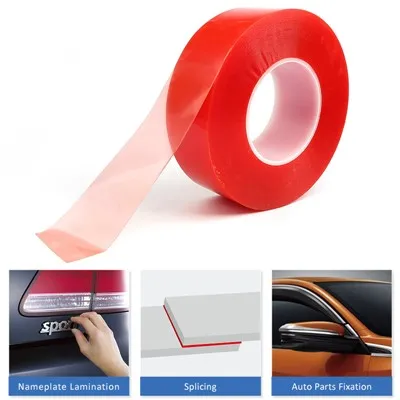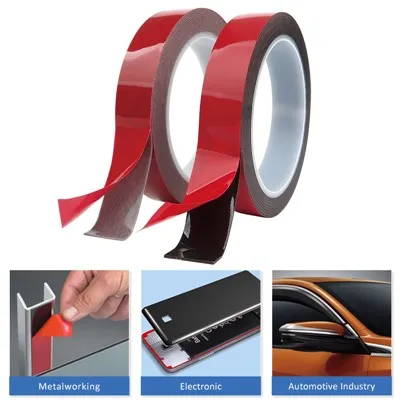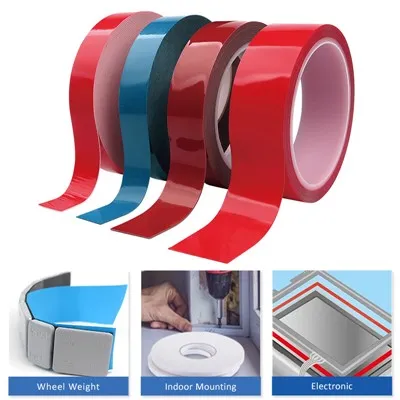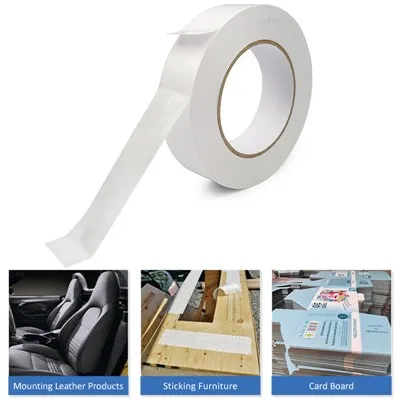
In precision industrial assembly and signage manufacturing, choosing the right bonding method directly impacts product durability and appearance. Many purchasing managers often ask, "Since both are double-sided adhesives, why should I abandon substrate-based (PET/paper) tapes and choose substrate-free transfer tapes?"
What is Substrate-Free Double-Sided Adhesive Transfer Tape?
Transfer tape is a pure adhesive film; it has no intermediate layer (carrier). The pressure-sensitive adhesive layer is directly applied to the release liner. During use, the adhesive layer is directly transferred to the part surface. In contrast, substrate-based tapes (scrim/carrier tapes) are like a sandwich: there is a layer of PET film, paper, or foam in the middle, with adhesive applied to both sides.
Why Choose Transfer Tape?
Extreme Thinness and Transparency:
If your design requires "zero-gap" bonding or high transparency (such as mobile phone screen assembly or membrane switches), Transfer Tape is the only choice. It has no added thickness from the substrate, typically only 0.05mm to 0.13mm.
Superior Flexibility and Conformability:
Due to the absence of a rigid substrate, the adhesive layer has a liquid-like flowability, perfectly filling the tiny gaps in uneven surfaces. This makes it exceptionally well-suited for curved surfaces, stamped parts, or textured metal nameplates.
Enhanced Weather and Temperature Resistance:
The substrate (especially cotton paper or inferior PET) is often the bottleneck for the temperature resistance of tapes. Pure acrylic Transfer Tape can typically withstand more extreme temperatures (up to 150°C and above) and chemical solvents because there is no substrate that will undergo thermal shrinkage or degradation.
Easy Die-Cutting:
In precision die-cutting, substrate-free tape achieves very clean edges, eliminating issues like substrate stringing or excess adhesive.
Which should I choose?
For easier decision-making, please refer to the table below:
| Dimensions | Substrate-Free Adhesive (Transfer Tape) | Adhesive Tape with Substrate (PET/Tissue Tape) |
| Thickness | Extremely thin (typically 2-5 mil) | Thicker (including substrate thickness) |
| Shape Adaptability | Extremely high, suitable for complex curved surfaces | Generally limited by substrate rigidity |
| Handling Ease | Low (adhesive layer easily stretches and deforms) | High (substrate provides dimensional stability) |
| Temperature Resistance | Excellent (pure adhesive layer is more stable) | Generally (limited by substrate heat resistance) |
| Typical Applications | Signage, membrane switches, foam bonding | Paper splicing, plastic part fixing, and manual pasting |
Typical Application Examples:
Scenario A: Adhesive for foam and padding
Recommendation: Transfer Tape.
Foam itself is highly compressible. Using substrate-free tape ensures the adhesive penetrates the foam fibers, achieving a seamless bond, while substrate-supported tapes compromise this flexibility.
Scenario B: Large-area manual bonding
Recommendation: Substrate-supported tape (e.g., PET substrate).
If you are manually bonding large areas, transfer tape, lacking support, is prone to curling or stretching when removing the release paper. In this case, a PET substrate provides excellent dimensional stability.
Scenario C: Nameplates and membrane switches
Recommendation: Transfer tape
Requires long-term UV resistance, chemical corrosion resistance, and extreme thinness to ensure tactile feedback.
As experts in industrial bonding, we recommend considering the following three key indicators before selection:
Surface Energy: For difficult-to-bond materials such as PP/PE, even substrate-free tapes require modified acrylic adhesives.
Stress Distribution: Substrate-free tapes perform excellently under static shear forces, but for applications involving high peel forces, substrate-coated tapes may provide better support.
Processing Environment: Automated lamination equipment prefers transfer tapes, while manual assembly recommends substrate-coated tapes to improve yield.