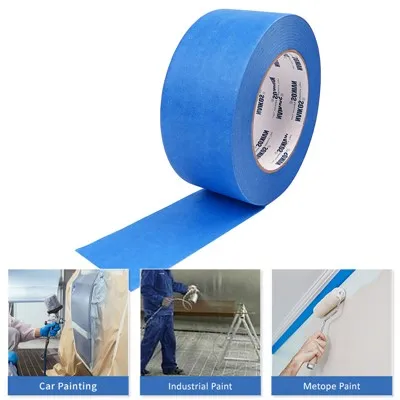
Among the many industrial adhesive solutions, high-temperature washi tape has become the material of choice for specific harsh environments due to its unique heat resistance, strength, and ease of use. Whether it is electronic manufacturing, the automotive industry, spray masking, or high-temperature encapsulation, this seemingly simple tape plays a key role.
High-temperature washi tape uses high-strength, tear-resistant washi paper. Unlike ordinary paper, washi paper is usually made of long fibers and has excellent tensile strength, flexibility, and high-temperature stability. This is the basis for its ability to maintain physical integrity at high temperatures.
It is the perfect combination of washi paper substrate and high-temperature adhesive that gives high-temperature washi tape the following core characteristics:
Excellent high temperature resistance: It can work stably for a long time within the specified temperature range (such as 150°C, 180°C, 200°C, 260°C, etc.) without melting, shrinking, or brittleness.
High strength and tear resistance: The washi paper substrate provides good mechanical strength and tear resistance, which makes it easy to operate manually or by machine.
Excellent adhesion and retention: Maintains good adhesion to a variety of materials (metal, glass, plastic, ceramic, etc.) even at high temperatures.
Good chemical and solvent resistance: Resists corrosion from a variety of chemicals, greases, and solvents (depending on the adhesive type).
Excellent electrical insulation: Silicone tapes, in particular, are ideal insulating materials for electrical and electronic applications.
Clean unwinding, easy tearing and sticking, no residual adhesive: Designed with ease of use in mind.
With its unique properties, high-temperature washi tapes are indispensable in the following industrial scenarios:
Electronic and electronic manufacturing (PCBA/SMT):
Wave soldering/selective wave soldering masking: Protects gold fingers, connectors, and other parts from high-temperature solder corrosion. High-temperature washi tape is the preferred masking material.
Reflow soldering masking: Used when local protection is required for specific components or areas.
Component fixing and insulation: Temporarily fix components during assembly or testing, or provide electrical insulation.
Coil/transformer binding and insulation: High temperature resistance makes it suitable for insulation binding inside motors and transformers.
Automotive industry:
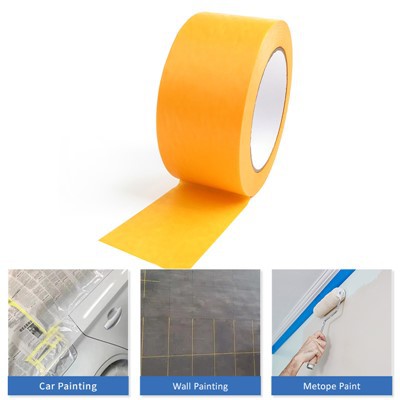
High temperature spray masking: Provide precise masking during painting and powder spraying in high temperature areas such as engine compartment components and near exhaust pipes.
Wire harness bundling and protection: Bundle and protect wire harnesses in high-temperature environments (such as engine compartments).
Temporary fixation and assembly assistance: Fix parts in high-temperature curing processes (such as sealant and structural adhesive curing).
Home appliance manufacturing:
High temperature spray masking: Used for ovens, barbecue grills, radiators, and other parts that require high temperature spray masking.
Internal wire harness fixing and insulation: Used near heating components.
Industrial manufacturing and maintenance:
High temperature powder spray masking: Need to withstand the high temperature of powder curing and baking.
Sealing and packaging in high temperature environments, Such as temporary sealing of gaps in industrial ovens and hot air ducts.
High temperature bundling and protection: Bundle high temperature pipeline cables, or protect non-processing areas of workpieces during heat treatment and welding.
Grinding wheel fixation: Fixing the grinding wheel during grinding and cutting operations.
Others:
Research and laboratory: Experimental environment that requires high-temperature resistant bonding or masking.
High-temperature label substrate: Used as the substrate for labels that need to withstand high-temperature environments.
Best practices for using high-temperature washi tape
Surface cleaning: Make sure the surface to be bonded or masked is clean, dry, and free of oil, dirt, and dust. This is the prerequisite for a good bonding effect.
Appropriate pressure: Apply appropriate pressure when pasting to ensure that the tape is in full contact with the surface.
Temperature and time: Understand how long the tape can withstand a specific temperature. Even high-temperature tapes may degrade in performance if they are exposed to extreme temperatures for a long time.
Removal time: For masking applications, it is usually easier and reduces the risk of residual adhesive to remove the tape as soon as possible after the high-temperature process (such as welding, spraying, curing) cools down. Avoid tearing at high temperatures.
Storage conditions: Store in a cool, dry, dark environment and avoid extreme temperatures.
Future trends of high-temperature washi tape
With the development of industrial technology, the requirements for high-temperature washi tape are also increasing:
Higher temperature resistance: Meet the needs of emerging fields (such as more efficient motors, power electronics, and aerospace) for higher operating temperatures.
Better overall performance: While maintaining high heat resistance, pursue lower unwinding force, better flexibility, stronger resistance to specific chemical solvents, and more thorough no residual glue performance.
More environmentally friendly materials: Use renewable or bio-based materials to develop more environmentally friendly high-temperature adhesives.
Functionality enhancement: Such as developing high-temperature tapes with electrical conductivity, thermal conductivity, or other special functions.
High-temperature washi tape is are high-performance materials that solve the challenges of bonding, fixing, shielding, and insulation in high-temperature environments. With the iteration of technology, high-temperature washi tape will continue to play an indispensable role in industrial manufacturing.