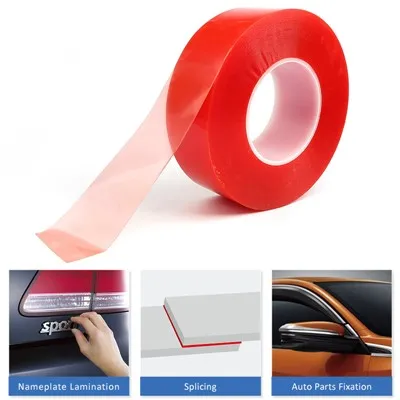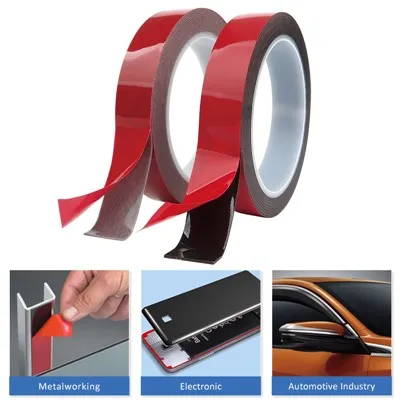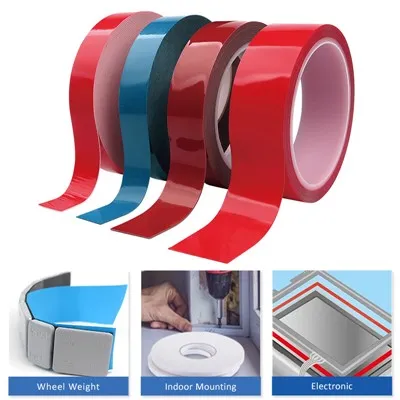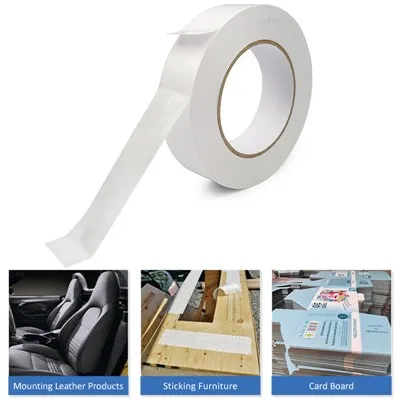
The science of adhesive tape, a crucial connecting material in electronic assembly, industrial manufacture, and even our daily life, has steadily advanced. Because of its special benefits, double-sided transfer tape, a high-performance bonding solution, is progressively taking the place of conventional mechanical fastening techniques in numerous applications.
The phrase "backingless" refers to double-sided tape that does not have an intermediary "backing." Two sticky layers and an intermediate backing layer (such as PET film, tissue paper, or foam) make up traditional double-sided tape. In contrast, double-sided transfer tape does not have a separate carrier layer and is simply coated with pure adhesive, occasionally with the help of a very thin release film for support and protection.
Among its primary characteristics are:
Lightweight and incredibly thin: By removing the backing, it becomes incredibly thin, usually between 10 and 50 microns, scarcely increasing the bonded component's overall thickness. This makes it perfect for applications where space is at a premium.
High bond strength: A 100% contact area is achieved by the adhesive immediately touching the adherend surface, producing a very high initial tack and ultimate peel strength.
Uniform Stress Distribution: In the absence of solid substrates, the bonding force is dispersed uniformly throughout the bonding surface, preventing the concentration of point stresses and minimizing warping and peeling over time.
Superior Heat and Weather Resistance: The premium acrylic adhesive provides superior protection against oxidation, UV radiation, and extremes in temperature.
Core Applications for Double-Sided Transfer Tapes
Thanks to these properties, double-sided transfer tape has become an indispensable component of many high-end manufacturing industries.
One of its biggest application areas is consumer electronics. It is utilized to bind internal structural components in laptops, assemble tablets and smartwatches, and secure screens, batteries, mid-frames, and graphite heat sinks in cellphones. The move toward lighter and thinner technology is precisely reflected in its lightweight design.
Automobile Interiors and Manufacturing: Used to fuse optical lenses (such backup cameras), side skirts, door frame moldings, instrument panel parts, and automobile logos. The tape must have outstanding weather resistance, meaning it must be able to survive vibration, bright sunshine, and extremely cold temperatures. Used to secure mirrors, skirting boards, metal ornamental strips, signage, and other items in construction and home décor. It offers a secure, aesthetically beautiful, and non-destructive installation approach.
How to Choose a Double-Sided Transfer Tape?
Choosing the right double-sided transfer tape isn't just about viscosity; several key factors must be considered:
Surface Energy Matching: The adherend's surface energy is the most important factor. Glass, metal, and ABS engineering plastics are examples of high-surface-energy materials that are simple to bond and come in a range of grades. PP, PE, and PTFE are examples of low-surface-energy materials that require backingless double-sided tapes with specific surface treatments.
Needs for Adhesion Strength: Assess if shear or peel strength is needed. Peel strength is more significant for surfaces that need smooth adherence, whereas high shear strength is essential for holding heavy items in place or under prolonged tension.
Environmental Tolerance: Take into account whether the application environment will be subjected to UV radiation, chemicals, high and low temperatures, or dampness. For instance, a very weather-resistant quality is needed for exterior vehicle applications.
Both die-cutting and thickness Processability: Depending on the design clearance, use the right tape thickness. Additionally, the tape's cohesiveness needs to be high enough to avoid glue strands and overflow during die-cutting if precise die-cutting is needed.