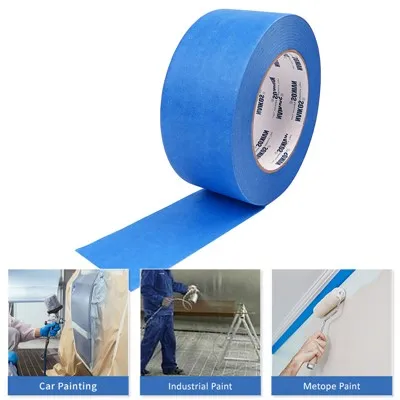
Blue masking tape is made from specially treated crepe paper coated with a rubber-based or acrylic pressure-sensitive adhesive. Its distinctive blue color is not a random choice, but an industry standard, typically used to indicate medium temperature and medium adhesion levels. Blue masking tape plays a vital role in various applications, including spray painting, masking, decoration, color separation, electronic component protection, and even creative handicrafts.
Features of Blue Masking Tape
The following benefits are provided by premium blue masking tape:
Moderate adherence: Offers strong adherence, leaving no residue when removed, and doesn't harm the object's surface (such as paint, metal, glass, plastic, etc.).
Excellent Temperature Resistance: Suitable for most spray painting and drying settings, it can endure brief high temperatures of 80°C to 120°C.
Solvent Resistance: Makes sure that masking lines are sharp and clear by preventing solvents from penetrating paints and varnishes.
Classic and Innovative Applications of Blue Masking Tape
Core Industrial and Decoration Fields:
Spray Painting Masking: Essential for boundary protection during automotive paint repair and mechanical product spraying, crucial for achieving color separation and sharp lines.
Decoration Color Separation and Protection: Wall paint color separation, door and window frame protection, and protecting hardware during wood painting.
Electronics Industry: Temporary masking and protection of gold fingers or specific areas during wave soldering and reflow soldering of printed circuit boards (PCBs).
Extended and Innovative Applications:
Marking and Positioning: Used as temporary marking lines or positioning aids during installation and construction.
Light Packaging and Sealing: Temporarily securing lightweight items.
Creative DIY and Art Creation: Thanks to its easy-tear and residue-free properties, it has become a common tool in journaling, painting, and design.
How to Identify High-Quality Blue Masking Tape?
The quality of blue masking tape on the market varies. As a manufacturer, we recommend evaluating it from the following aspects:
Smell: High-quality acrylic adhesive has a very faint or no odor. Products with a strong, irritating odor may use an inferior adhesive, resulting in poor weather resistance and environmental performance.
Viscosity and Peel Test: After application, the tape should adhere firmly and peel off smoothly without tearing, paper delamination, or adhesive residue. A simple "stick-and-peel" test can be performed.
Observe Edges and Material: The cut edges should be neat and free of burrs. The masking tape base material should be soft and flexible, not easily torn by hand.
Check Packaging and Information: Legitimate products will clearly indicate specifications (width, length), temperature resistance range, and viscosity values. Inquire whether the manufacturer has relevant quality certifications (such as ISO standards).
Test Solvent Resistance: Apply a small amount of paint or solvent to the tape surface and observe whether it penetrates to the back. Non-penetration is essential for ensuring effective masking.
Blue Masking Tape Market Trends and Future Outlook
With the continuous improvement of precision and environmental protection requirements in the manufacturing and decoration industries, there is a growing demand for higher-performance blue masking tape:
Higher Precision: Requirements for cutting width tolerance and roll neatness are becoming increasingly stringent.
More Environmentally Friendly: The widespread use of water-based paints requires tapes with better water resistance; at the same time, environmentally friendly adhesives with lower VOC (volatile organic compounds) content are becoming a trend.
Functional Segmentation: The market for special blue masking tapes for specific scenarios (such as halogen-free requirements in the electronics industry and higher temperature resistance requirements in the automotive industry) is expanding.
Blue masking tape, as a basic but crucial industrial consumable, its selection directly affects work efficiency and product quality. Choosing a professional tape manufacturer with strong technology and stable quality is essential.