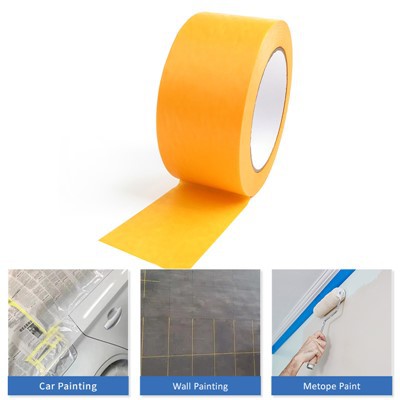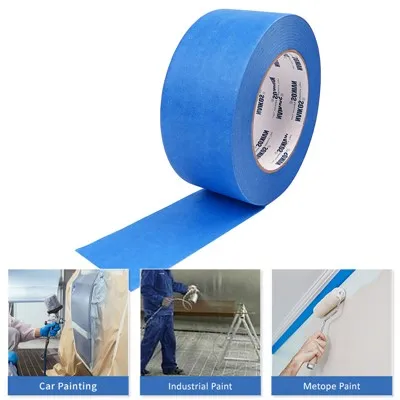
In body shops, furniture workshops, and construction sites, you'll always see that familiar blue. It's not just a decorative element; it's a crucial barrier in precision work-blue masking tape. For professionals, its value goes far beyond simply holding things together; it lies in its reliable ability to create "perfect boundaries."
Naikos crepe paper masking tape consists a crepe paper. It is suited for any paint application in furniture construction, work sites, and industrial contexts.
Core Applications: A Diverse World Beyond Automotive Painting
Although blue masking tape is most commonly associated with automotive painting, its uses are far more diverse.
Automotive painting and sheet metal repair: This is its classic battlefield. It's used to precisely mask window chrome strips, headlights, logos, and non-painted sheet metal areas, ensuring paint doesn't contaminate these areas and creating sharp color boundaries.
Wood, furniture, and hardware painting: When painting furniture and wood, it's used to create straight lines, geometric patterns, or to protect specific areas. Its flexibility is ideal for complex edges in furniture.
Construction and Renovation: Used for painting baseboards, window and door frames, switches, and plugs, as well as for applying temporary positioning tape and spray-on protective film.
Light Industrial Encapsulation and Fixing: Due to its ease of removal, it is also commonly used for temporary component attachment during product assembly, marking regions, and lightweight packing and sealing.
Expert Buying and Usage Guide: Avoiding Common Pitfalls
Improper selection or operational errors can lead to masking failures, resulting in costly rework. Here are the key points:
Buying Tips:
Determine the Content: To test the tape's ductility and toughness, pull it. Dense fibers, a consistent sticky surface, and ease of tearing are characteristics of superior products.
Test Adhesion: To see if there is any adhesive residue, place the tape on glass or stainless steel, press, and then immediately remove. The quickest method for checking for adhesive residue is this one.
Verify your intended usage environment by identifying it. There are blue masking tapes that are resistant to high temperatures that can be used in high-temperature paint booths. These tapes can tolerate baking temperatures that are higher than 110°C for brief periods of time.
Usage Tips
The application surface must be completely clean, devoid of any dust, moisture, or oil. Paint can leak through if any impurities damage the adhesive bond.
Fingertip compaction: To ensure a seal, use your fingertips or a tongue depressor to fully crush the edges after application, particularly on bumpy or uneven surfaces.
Time window: The majority of blue masking tapes are not made to be used for extended periods of time. After application, they should be taken off within 24 to 72 hours. The likelihood of adhesive residue is increased by prolonged exposure to sunshine or extremely high or low temperatures.
For a clean, residue-free application, use a gentle peel and angle pull technique. After applying the tape, remove it evenly and gently at a 45° or 180° angle, avoiding jerky, abrupt movements. This guarantees the purest peel imaginable.