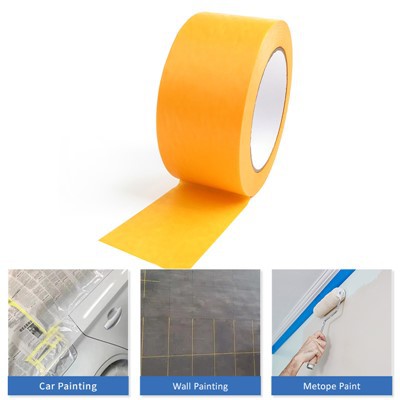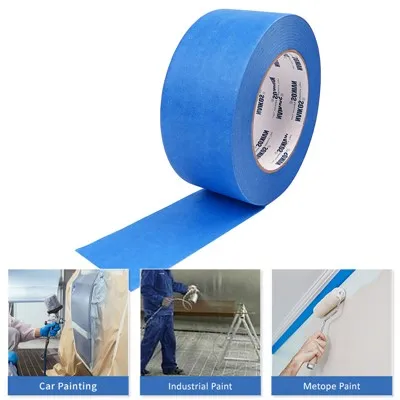
In the automotive repair and detailing industry, the misconception that "tape is just tape" is a costly one. While automotive masking tape and ordinary painter's tape may look similar, their chemical composition and physical properties are vastly different.
Technical Specifications Comparison Table
To quickly understand the differences, we have compiled the following comparison of key parameters:
| Feature | Automotive Grade Masking Tape | General Purpose Painter's Tape |
| Temperature Resistance | Typically up to 80°C - 120°C | Typically below 60°C |
| Solvent Resistance | Very strong (resistant to paint thinners, varnishes) | Weak (solvents easily penetrate, leading to adhesive failure) |
| Substrate Construction | High-grammage saturated crepe paper/polymer film | Ordinary lightweight paper |
| Adhesive Type | High-grade synthetic rubber or cross-linked resin (leaves no residue) | Ordinary pressure-sensitive adhesive (melts easily when heated) |
| Stretchability | Excellent, conforms to body curves | Easily tears, only suitable for straight lines |
Why can't ordinary tape be used for automotive painting?
High Temperatures in the Paint Booth
Automotive painting usually involves a drying process. Automotive-grade tape is designed to operate continuously at temperatures around 100°C without deterioration. In contrast, ordinary painter's tape experiences "thermal migration" of its adhesive at temperatures exceeding 60°C, resulting in a large amount of adhesive residue left on the car paint surface after removal. Cleaning this residue often requires secondary polishing or even damages the newly painted surface.
Solvent Penetration and "Bleeding"
Automotive paint contains strong solvents. Ordinary painter's tape has a loose paper structure, allowing solvents to penetrate the substrate and dissolve the adhesive, causing the tape edges to lift and paint to seep in, forming jagged edges. Professional automotive tape is treated with a solvent-resistant coating to ensure sharp, clean edges (Sharp Paint Lines).
Conformability to Body Curves
Car bodies are full of complex curves and contours. Ordinary tape easily tears when stretched or wrinkles at curves. Automotive-grade masking tape (especially Fine Line Tape) possesses extremely high toughness and elasticity, allowing it to conform tightly to curved areas such as bumpers and wheel rims.
How to identify high-quality automotive masking tape?
As a professional buyer or technician, you can test it from the following three dimensions:
Stretch Test:
Try applying the tape around a cylindrical object and observe if the edges lift.
Solvent Resistance Test:
Apply a small amount of thinner to the back of the tape and observe whether the adhesive becomes sticky or softens after 5 minutes.
Removal Test:
After applying the tape to a metal plate, place it in an 80°C environment for 30 minutes. After cooling, observe whether it can be removed "completely and without residue."
Industry Expert Advice:
"If you are working with water-based paint, be sure to choose green or blue automotive masking tape labeled 'Water-resistant'. Ordinary yellow paper tape will lose its adhesion after contact with water-based paint due to water absorption, resulting in masking failure."
Choosing the right tools is fundamental to professional craftsmanship. Although ordinary masking tape has a lower unit price, the hidden costs of adhesive residue cleanup and rework far outweigh the price difference of the tape itself. For professionals who pursue perfect paint finishes, automotive-specific masking tape is the only choice.