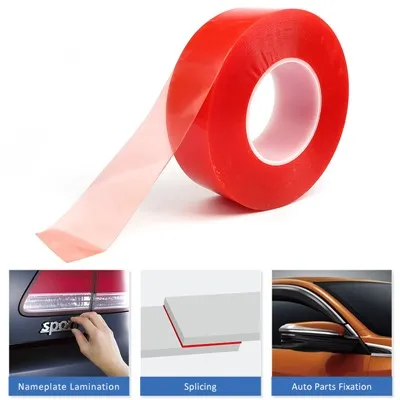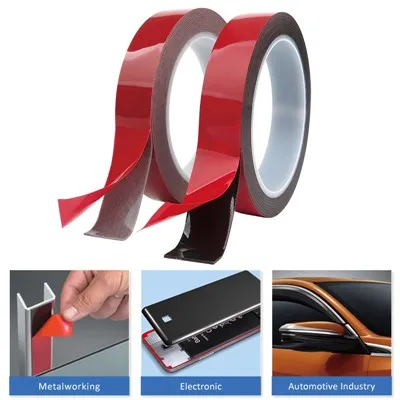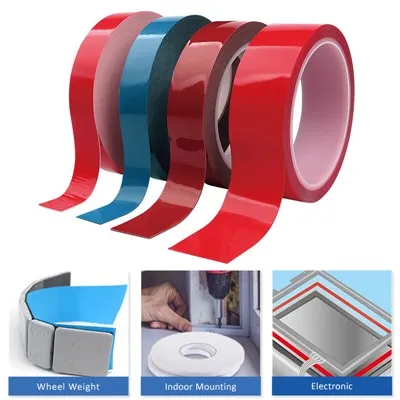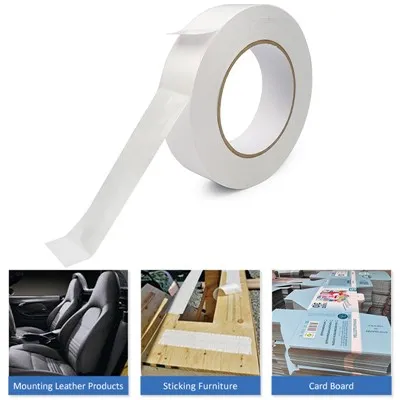
Acrylic foam tape is a composite tape made with a closed-cell foam base material coated on both sides with a high-performance acrylic pressure-sensitive adhesive. Unlike traditional double-sided tape, its core lies in the unique combination of the "foam" layer and the "acrylic adhesive."
Important Features:
Superior Adhesion and Durability: The acrylic adhesive exhibits excellent adhesion to a wide range of surfaces, thanks to its exceptional initial tack and strong final peel strength. Additionally, it exhibits outstanding resilience to weather, UV light, and chemical solvents, maintaining its adhesive properties for an extended period without deterioration.
Outstanding Cushioning and Shock Absorption: The foam base material effectively absorbs stress and disperses load, compensating for deformation caused by thermal expansion and contraction or vibration of the bonding surface, preventing delamination. This is a key advantage that distinguishes it from pure adhesive film tapes.
Excellent Filling and Sealing Effect: The foam may achieve good surface contact by filling uneven and rough bonding surfaces. It also offers some degree of sound, moisture, and dust insulation.
Many Thickness Choices: Flexible selection based on cushioning, filling, and spacing needs is made possible by the thicknesses, which range from a few tenths of a millimeter to several millimeters.
Main Classifications and Application Fields of Acrylic Foam Tape
To satisfy the demanding requirements of various industries, acrylic foam tape can be classified into a number of subcategories based on variations in foam base material density, thickness, color, and adhesive properties.
General-Purpose Acrylic Foam Tape
Features: High cost-effectiveness, balanced cushioning, and adherence.
Applications include lightweight material bonding, mending home items, and installing indoor signage.
High-Adhesion/High-Performance Acrylic Foam Tape
Features: Employs improved acrylic adhesive with very high peel strength and higher resistance to aging and high temperatures (short-term resistance to over 120°C).
Applications: Automotive industry (decorative strips, pedals, signs, component fixing), elevator car panel installation, metal frame bonding, etc.
VHB (Very High Bond) Acrylic Foam Tape
Features: Ultra-high strength and ultra-durability. Some models can replace mechanical fastening methods such as welding and riveting, achieving structural bonding.
Applications: Installation of metal panels for building curtain walls, bonding of large steel structures, assembly of truck body panels, installation of solar panel mounting brackets, etc.
Conductive or Insulating Acrylic Foam Tape
Features: Electromagnetic shielding (EMI/RFI) or electrical insulation is achieved by incorporating conductive particles into the foam or using insulating materials.
Applications: include assembling precise instruments, grounding electronic device casings, and fastening shielding covers.
Ultra-thin and High-compression Acrylic Foam Tape
Features: Extremely thin (can be less than 0.2mm) or with very high resilience, suitable for space-constrained applications and those requiring repeated compression.
Applications: Fixing internal components of mobile phones/tablets, LCD module assembly, shock-absorbing pads for precision equipment, etc.
Why should I use acrylic foam tape?
Process simplification and increased effectiveness: There is no need for drilling, welding, or grinding; there is no thermal distortion; the production process is clean and eco-friendly; and the final product has a smooth, clean appearance.
Even stress distribution: Surface contact bonding improves the components' overall strength and fatigue life by distributing stress uniformly and preventing stress concentration brought on by point connections.
Outstanding resilience to the environment: Excellent resistance to moisture, UV rays, and cycles of high and low temperatures guarantees long-term dependability in challenging outdoor settings.
Decreased weight and expense: minimizes the usage of mechanical fasteners, which directly lowers structural weight (particularly crucial for aerospace and automotive applications) and production costs.
How can I pick the best acrylic foam tape?
As a manufacturer, we recommend that you evaluate the following dimensions:
Substrate surface: Clearly state the kind of material to be bonded as well as its surface energy. Adhesives with specific treatments are needed for materials with low surface energy.
Operating environment: Take into account the temperature range, whether it will be in direct sunlight, whether it will come into contact with chemicals or oils, and whether flame retardancy is necessary.
Stress conditions: Analyze whether it will withstand persistent static shear force (such as hanging heavy objects), peeling force (such as sign installation), or impact vibration. Different acrylic foam tape formulations are open to different types of forces.
Gap filling and thickness requirements: Measure the unevenness or design gap between the bonding surfaces, and select the appropriate tape thickness and compression performance. Process requirements: Consider whether the unwinding force, bonding speed, and initial tack meet the requirements for automated or manual assembly.
In addition to providing a comprehensive assortment of acrylic foam tapes, as a professional tape producer, we also offer expert technical selection support and tailored solutions depending on your particular application scenarios. The first step to a successful bond is making the proper decision.
Please get in touch with us to find out more about the appropriate kind of acrylic foam tape for your project or to request free samples for testing. Allow our experience to assist you in achieving more design freedom and stronger product relationships.