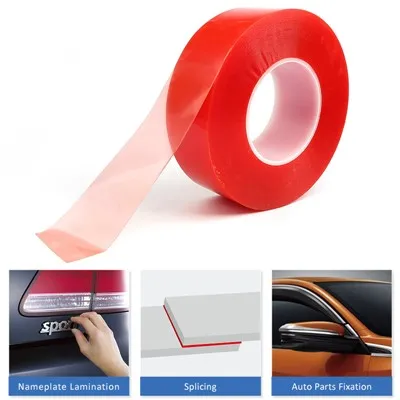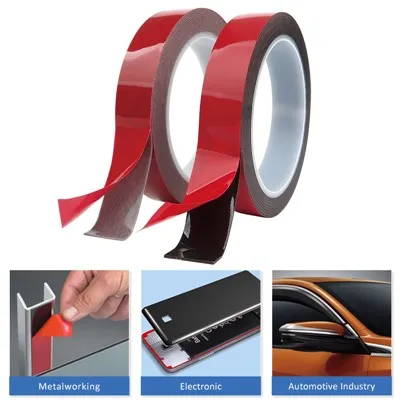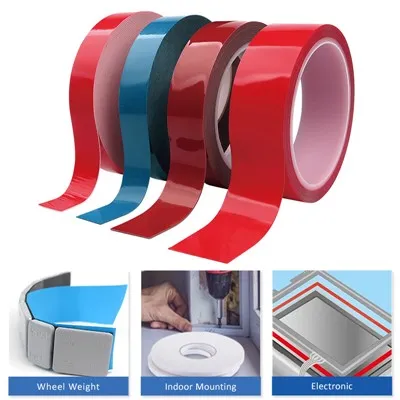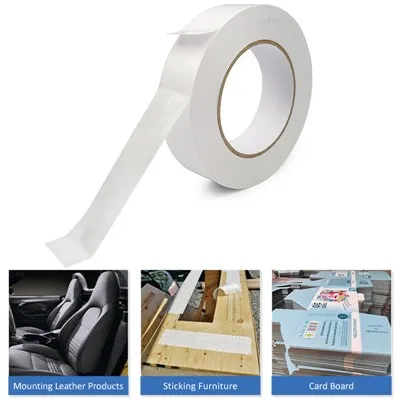
Acrylic foam tape is a double-sided adhesive tape with an acrylic foam core and a modified acrylic adhesive on both sides. The foam core provides cushioning and conformability, while the adhesive provides excellent bond strength even on difficult-to-bond surfaces. Acrylic foam tape is widely used in automotive, construction, electronics, and many other industries for bonding, sealing, and mounting applications.
Acrylic foam tape consists of a foam core made of closed-cell acrylic foam, which is coated on both sides with an acrylic adhesive. The foam core provides compressibility and flexibility, allowing it to conform to irregular surfaces and absorb thermal expansion and contraction. The adhesive provides high initial tack and long-term holding power, even in harsh environments.
Acrylic foam tape offers several advantages over other types of adhesive tape:
1. High bond strength: Acrylic foam tape provides a strong and durable bond, even on uneven or textured surfaces.
2. Weather and UV resistance: Acrylic foam tape is resistant to weather and UV light, making it ideal for outdoor applications.
3. Vibration damping: Acrylic foam tape can absorb vibrations and reduce noise, making it suitable for automotive and industrial applications.
4. Conformability: Acrylic foam tape can conform to irregular surfaces, providing a uniform bond.
5. Easy to apply: Acrylic foam tape is easy to apply and can be cut to size with scissors or a knife.
Acrylic foam tape is used in a wide range of applications, including:
1. Automotive: Acrylic foam tape is used for bonding and sealing automotive exterior trims, badges, emblems, and mirrors, as well as for mounting interior trim components, such as door handles, dashboard panels, and headliners.
2. Construction: Acrylic foam tape is used for bonding and sealing building facades, curtain walls, and cladding panels, as well as for mounting signs, nameplates, and dispensers.
3. Electronics: Acrylic foam tape is used for bonding and sealing electronic components, such as LCD displays, touch screens, and camera modules, as well as for mounting thermal management devices, such as heatsinks and heat pipes.
4. Packaging: The packaging industry uses Acrylic foam tape to splicing and laminate paper, film, and foil substrates.
Selection criteria
When selecting acrylic foam tape, the following factors should be considered:
1. Bond strength: The tape should have sufficient bond strength to hold the application securely in place.
2. Temperature range: The tape should be able to withstand the temperature range of the application environment.
3. Surface type: The tape should be compatible with the surface to be bonded, whether it is smooth, textured, or painted.
4. Shear strength: The tape should have sufficient shear strength to resist sliding or slipping under load.
5. Thickness: The tape should have the appropriate thickness to accommodate any gaps or irregularities in the application.
Some common problems with acrylic foam tape include:
1. Delamination: This occurs when the tape separates from the substrate due to poor bonding. Delamination can be prevented by ensuring that the surfaces are clean and dry before applying the tape and by applying enough pressure during application.
2. Uneven bonding: This occurs when the tape does not bond evenly across the surface. Uneven bonding can be prevented by using the appropriate tape thickness and by ensuring that the surface is flat and free of debris.
3. Yellowing: This occurs when the tape turns yellow over time due to exposure to UV light. Yellowing can be prevented by using UV-resistant tape or by applying a protective coating over the tape.
Acrylic foam tape is expected to continue to grow in popularity, particularly in the automotive, construction, and electronics industries. The demand for lightweight, durable, and efficient bonding solutions is driving the adoption of acrylic foam tape over other types of adhesive tape. In addition, advances in technology are enabling the development of specialized tapes that can meet the specific needs of different applications, such as high-temperature resistance, biocompatibility, or electrical conductivity.