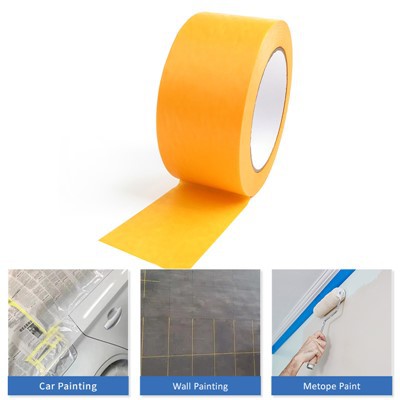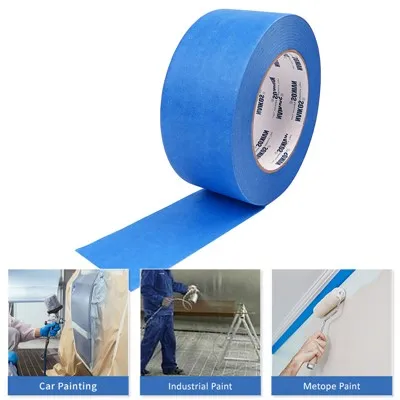
In painting, decoration, art creation, and many industrial fields, "masking tape" is synonymous with masking protection. Among them, blue masking tape has become a popular mainstream choice in the market with its unique performance and wide applicability.
Naikos crepe paper masking tape consists of crepe paper backing. It is suited for any type of paint application in furniture construction, work sites, and industrial contexts.
Blue masking tape key performance
Medium viscosity: Provides sufficient adhesion to resist paint penetration, while ensuring that it can be peeled off relatively easily and cleanly after masking is completed without damaging the substrate (such as wall, metal, glass, plastic, etc.).
Heat resistance: This is one of the most important properties of blue masking tape. High-quality blue tape can usually withstand temperatures of 60°C to 80°C or even higher, effectively preventing the tape from melting, glue overflowing, or being difficult to tear off under baking paint or high high-temperature environment.
Solvent resistance: It can resist the penetration of common paints and solvents, ensure that the masking edges are clear and sharp, without "bleeding" or "burrs", and achieve perfect color separation effects.
Easy to tear & flexibility: Easy to tear by hand, convenient for quick operation on site; good flexibility enables it to fit tightly to curved and irregular surfaces.
What are the main application scenarios of blue masking tape?
Spray painting and coating:
Automobile spray painting/repairing: Masking windows, lampshades, chrome strips, and areas that do not need to be sprayed are the main force for car body color separation masking.
Industrial equipment coating: Protect non-sprayed surfaces such as mechanical parts and pipe interfaces.
Furniture spray painting: Used for color separation and pattern masking of wood paint.
Building wall painting: Masking skirtings, door and window frames, switches, and sockets to achieve clear boundaries.
Electronic manufacturing industry:
In PCB board welding, wave soldering, and other processes, protect gold fingers, specific components, or areas from solder paste and flux contamination.
Temporarily fix components or logos.
Decoration and construction:
Paste protective ground film, door, and window protective film.
Temporarily fix drawings and logos.
Mask tile joints for beautiful joints.
Art and creativity:
Color separation painting and printmaking on canvas and paper.
Precise masking and pattern creation for handmade DIY projects.
Color separation spraying for model making (such as Gundam, military models).
General masking and fixing:
Lightweight packaging and sealing (temporary).
Temporary marking or fixing items in offices and homes.

How to choose high-quality blue masking tape?
Clear requirements:
Temperature resistance requirements: What is the maximum temperature of the environment you need to mask? It is safer to choose a tape with a temperature resistance level higher than the actual requirement.
Masking time: How long does the tape need to be pasted? For long-term masking (more than a few days), products with lower risk of residual glue and better aging performance should be selected.
Adhesive surface: Wall (latex paint, diatom mud), metal, plastic, glass, paper? Different surfaces have different requirements for stickiness and tearing. For sensitive surfaces (such as newly painted walls, certain plastics), be sure to choose ultra-low viscosity or "no residual glue" models.
Paint/solvent type: Are you using water-based paint, oil-based paint, or strong solvent-based paint? Make sure the tape has the corresponding anti-penetration ability.
Focus on the core parameters:
Temperature resistance: The maximum temperature resistance is marked on the product packaging (such as 70°C, 80°C, 100°C).
Adhesion: Usually expressed in N/cm or N/25mm. Medium viscosity (such as 3-6 N/25mm) is suitable for most masking scenarios. Too low is easy to warp, too high is difficult to tear, and easy to leave residual glue.
Thickness: Affects tensile strength and permeability resistance, generally around 0.13mm - 0.18mm.
Basic weight: The gram weight of paper (g/m²), which affects strength and stiffness.
Certification: For specific industries (such as automotive original equipment, electronics), are there relevant certifications (such as ISO, RoHS)?
Best practices for using blue masking tape
Surface cleaning: Make sure the surface to be adhered to is dry, clean, and free of oil and dust. This is the basis for ensuring the bonding effect and clean tearing.
Press the edge: After pasting, be sure to press the edge of the tape firmly with your fingers, scraper, or special roller, especially on curves and corners, to form an effective seal and prevent paint from penetrating.
Remove in time: After the paint is dry (follow the paint instructions), remove the tape as soon as possible. Waiting for the paint to completely dry and solidify before tearing it off sometimes increases the risk of edge cracking or lifting the paint film (especially on latex paint walls). When tearing it off, keep an angle of 180 degrees or more, and tear it off slowly and evenly.
Avoid stretching: Avoid excessive stretching of the tape when pasting; otherwise, the retraction during removal may cause uneven edges or damage the paint film.
Storage: Store in a cool and dry place, away from direct sunlight and high temperature, and humidity.
Blue masking tape has become a must-have tool from professional paint shops to home DIY due to its excellent comprehensive performance - reliable masking effect, good temperature resistance, resistance to solvent penetration, and relatively clean tearing performance.