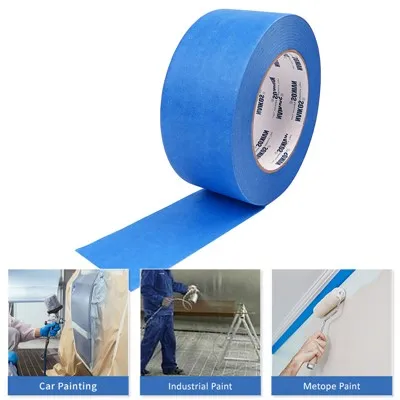
In the world of adhesive products, colored masking tape has long surpassed simple functional tools with its unique charm and practicality, and has become an indispensable star product in creative design, home decoration, industrial protection, and even precision operations.
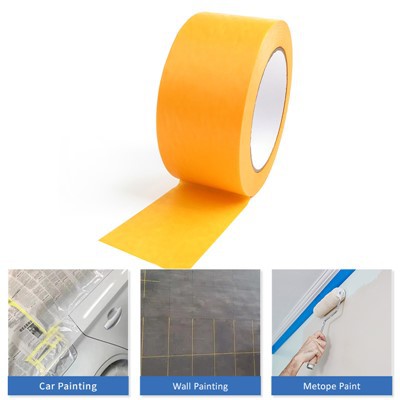
Naikos colored masking tape consists of a crepe paper backing. It is suited for any type of paint application in furniture construction, work sites, and industrial contexts.
Advantages of colored masking tape
Colorful colors, visual identification:
A variety of bright colors is its biggest feature. It is not only beautiful, but also can be used to quickly distinguish, mark areas, and classify management to improve work efficiency and visual recognition.
Easy to tear and stick, convenient operation:
The masking paper substrate gives it excellent hand-tearing (no scissors are required), and the edges are neat, which is convenient and quick to take and stick.
Moderate viscosity, no trace of removal:
When used correctly (especially on medium viscosity and standard surfaces), it usually does not leave residual glue after removal and does not damage the adhered surface (such as walls, paper, glass, metal, paint, etc.), which is the first choice for fine masking and protection.
Flexible and docile, precise masking:
The paper substrate is soft and can fit curves and irregular surfaces well, achieving precise masking, especially suitable for border protection during painting and brushing.
Good air permeability (partial):
The paper itself has a certain air permeability, which is conducive to moisture volatilization in certain processes (such as wall paint), reducing the risk of blistering and peeling (but not all models emphasize this feature).
Writing performance: The surface of most colored masking tapes can be written with markers, ballpoint pens, etc., which makes it easy to record information.
Core application scenarios of colored masking tapes
Creative handicrafts and notebook decoration:
This is its most well-known application. Rich colors and patterns (solid colors, prints, etc.) are excellent materials for making notebooks, greeting cards, DIY handicrafts, gift packaging, and arranging photo walls, providing unlimited creative possibilities.
Building decoration and spray painting, masking:
Wall painting: Mask door and window frames, skirtings, switches and sockets, corner lines, etc., to ensure clear boundaries and neat edges of paint and coatings.
Wood/metal spray painting: Protect areas that do not need to be sprayed, such as glass, chrome-plated parts, and specific pattern parts.
Color separation masking: Different colored tapes mark different painting areas.
Daily use in the office and at home:
Document labeling and indexing: Color labels are eye-catching and easy to find.
Wall decoration and notices: Post posters, notices, photos (little damage to the wall).
Temporary fixing/bundling of items, such as fixing wires, wrapping bouquets, etc.
Teaching and demonstration: Making charts, mind maps, and partition signs.
Auto repair and maintenance:
Fine masking before painting to protect headlights, windows, decorative strips, etc.
How to choose high-quality colored masking tape?
Viscosity requirements:
Choose medium viscosity, high viscosity, or specific viscosity grades according to the application surface (smooth/rough) and the required bonding strength. Avoid using high-viscosity tape on fragile surfaces (such as newly painted latex paint walls and wallpaper).
Heat resistance:
If it needs to be used in high-temperature environments such as welding and baking, be sure to choose products that are marked as high-temperature resistant (such as 130°C, 150°C). Ordinary colored masking tapes have limited temperature resistance.
Substrate thickness and strength:
Thicker substrates have better tensile strength and permeability resistance, and are suitable for masking with high requirements (such as preventing paint penetration). Thinner ones are more economical and more compliant.
Tearability and edge neatness:
High-quality products should be easy to tear by hand, with smooth edges and no burrs, without effort.
Color fastness and permeability resistance:
The color should be uniform and full, and not easily fade. When used for masking, it should effectively prevent paint and coating from penetrating to the back of the substrate or penetrating through the edge of the tape (choose high-density substrate products).
Tips for using colored masking tape
Surface cleaning:
Make sure the surface is dry, clean, and free of oil and dust before pasting to obtain the best bonding effect and removal performance.
Press and fit:
After pasting, press along the tape with your fingers or a scraper to ensure that the edges are fully fitted to prevent paint from penetrating.
Timely removal:
Follow the recommended masking time in the product instructions. The best time to remove the paint/coating is after it has dried (usually within 1-2 hours, see the product instructions for details). Avoid removing it after the coating is completely cured (after a few days). Otherwise, the tape may be difficult to remove or the edges may be uneven due to shrinkage of the coating, which and even increase the risk of residual adhesive.
Angle control:
When removing, try to tear it off slowly at an angle of 180 degrees or close to 180 degrees (parallel to the surface) to reduce the possibility of residual adhesive or damage to the surface.
Storage environment:
Store in a cool and dry place, avoid direct sunlight and high temperature, and humidity to maintain the performance of the adhesive.