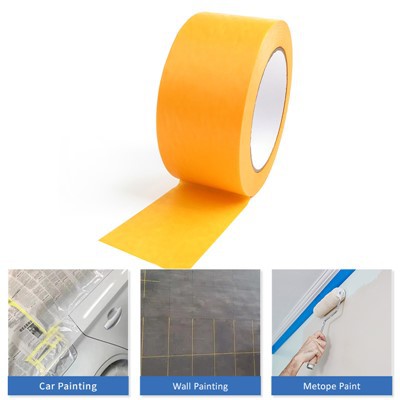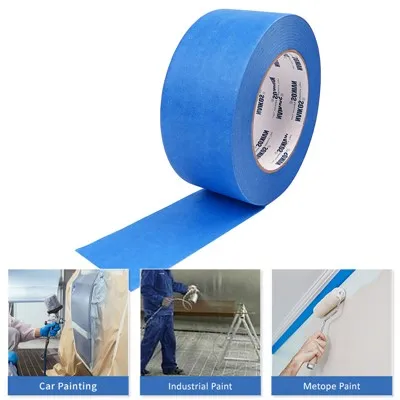
In the field of masking and protection, blue masking tape has become the tool of choice for many professionals and DIY enthusiasts due to its unique performance. Unlike ordinary masking tape or transparent tape, blue masking tape is designed for specific delicate work scenarios.
Why choose "blue"?
The blue masking tape is not chosen at random. Its iconic blue color is usually associated with a specific performance level (blue often represents medium viscosity/general purpose). Its core advantages are:
Moderate viscosity & clean removal:
This is its core value. It is sticky enough to stick firmly to various substrates (such as walls, wood, metal, glass, plastic), providing reliable masking protection. More importantly, it will hardly leave residual glue or damage the underlying surface (such as latex paint wall, car paint) when removed, even relatively sensitive paint or newly sprayed surface.
Solvent resistance:
Blue masking tape usually has good water resistance and solvent resistance (such as paint, paint thinner), ensuring that the paint will not penetrate the edge of the tape and cause "bleeding" during the painting or brushing process, and achieve a clear masking demarcation line.
Temperature resistance:
High-quality blue masking tape can withstand a certain range of temperature changes (the common temperature resistance range is about 60°C to 80°C, depending on the product specifications), and is suitable for most spraying operations at room temperature or light heating (such as car repair baking).
Flexibility & tearability:
With crepe paper as the base material, it has excellent flexibility and conformability, and can easily fit curved surfaces and irregular edges. At the same time, it is easy to tear by hand, which is convenient for quick on-site operations without scissors.
Surface writability:
The surface of the tape can usually be easily marked with a marker pen, which is convenient for identifying and managing the construction area.
UV resistance:
Some blue masking tapes designed for outdoor or automotive applications are also UV resistant, extending the effective period of masking.
Main application scenarios of blue masking tape
With the above characteristics, blue masking tape is very useful in many industries and scenarios:
Architectural decoration and painting:
Fine masking of door and window frames, skirtings, switches and sockets, and decorative lines when painting indoor walls (latex paint, water-based paint).
Create clear, straight lines, geometric patterns, or color separation lines.
Protect floors, furniture, lamps, etc. from paint splashes.
Automobile manufacturing and maintenance:
When repairing car paint, mask windows, lights, chrome trims, and non-spraying areas to ensure that the paint boundaries are sharp and free of burrs.
Protect sensitive parts of the car body.
Temporarily fix masking paper or plastic cloth.
Industrial manufacturing and electronics:
Protect specific areas of the product during processes such as spraying, sandblasting, and electroplating.
Temporary fixation or identification during the assembly of electronic components.
Masking during cleaning or chemical treatment.
DIY crafts and creativity:
Fine spray masking for model making (aircraft, car models).
Furniture renovation and transformation.
Creating special effects or protecting areas in creative painting and art.
General masking and fixing: Temporary fixing of lightweight items, packaging identification, office marking, etc.
Key points for purchasing blue masking tape
There are many brands of blue masking tape on the market, and the quality varies. When purchasing, pay attention to the following points to ensure the best performance and results:
Adhesion level:
Confirm that it is "medium viscosity" or "general purpose". Avoid products with too high or too low viscosity.
Surface adaptability:
Consider the substrates you use most often (such as smooth walls, textured walls, metals, plastics, automotive paint). Choose products marked for your target surface. For particularly sensitive surfaces (such as newly painted latex paint, aged walls, certain plastics), you should choose a model with lower viscosity and gentler.
Masking time:
Check the "masking time" marked on the product, which is the maximum time range recommended for removal after the tape is applied (such as 14 days, 21 days, 60 days). Beyond this time, the risk of residual adhesive when removing will increase significantly. Choose according to the construction period.
Temperature range:
Confirm whether its temperature resistance meets your job requirements, especially when it involves baking or high-temperature environments.
Solvent resistance:
Make sure it can resist the type of paint you will use (water-based paint, oil-based paint, solvent-based paint).
Specifications:
Choose the appropriate width (commonly 12mm, 18mm, 24mm, 36mm, 48mm, etc.) and length (meters or rolls) according to your needs.
Certification:
For specific industries (such as automobiles), check whether there are relevant industry certifications.