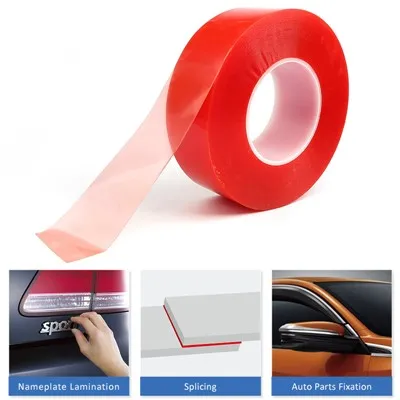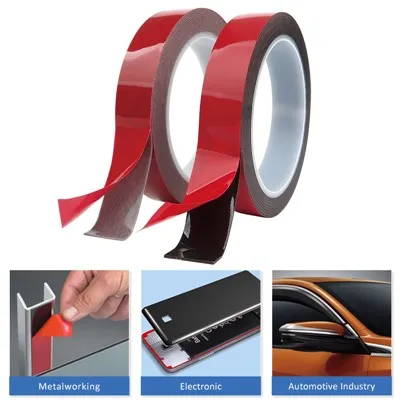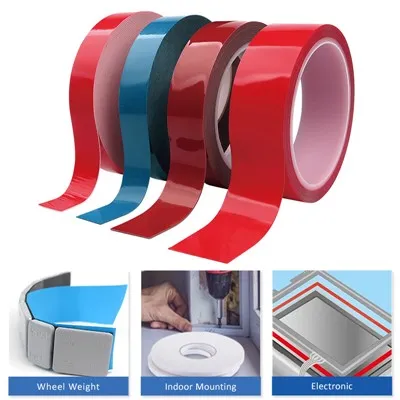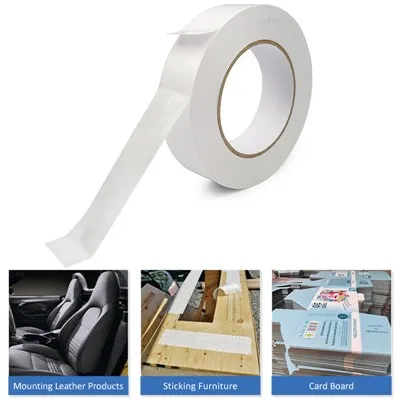
Among many adhesive tape products, acrylic foam tape has become an indispensable high-performance bonding solution in modern manufacturing, especially in electronics, automobiles, home appliances, construction, and other fields due to its excellent comprehensive performance. It is not only a tape, but also a precision engineering material.
Acrylic foam tape is a double-sided or single-sided tape made of acrylic ester (acrylic) pressure-sensitive adhesive coated on both sides or one side of a foam substrate (usually polyethylene, polyurethane, or acrylic foam). Its core components include:
Foam substrate: Provides thickness, elasticity, cushioning, gap-filling ability, and stress dispersion. Foams of different densities, thicknesses,s and open and closed cell structures give the tape different mechanical properties.
Acrylic pressure-sensitive adhesive: Provides bonding force. Acrylic adhesive is known for its excellent weather resistance, temperature resistance, chemical solvent resistance, UV aging resistance, and long-term stable bonding performance.
Release paper/release film: Protects the adhesive layer for easy die-cutting, transportation, and use.
Core features and advantages of acrylic foam tape
Why does acrylic foam tape stand out in many application scenarios? The key lies in its unique combination of properties:
Excellent bonding strength and durability: Acrylic glue can firmly bond various materials (metal, plastic, glass, painted surface, etc.), and does not easily decay significantly over time, providing long-term and reliable fixation.
Excellent weather resistance and aging resistance: It has strong resistance to ultraviolet rays, ozone, high and low temperatures (the operating temperature range is usually up to -40°C to +150°C, and can withstand higher temperatures in the short term), and humidity changes, and is suitable for indoor and outdoor environments.
Excellent chemical solvent resistance: It resists the erosion of various oils, detergents, and chemical solvents, and maintains bonding stability.
Good cushioning and shock absorption performance: The foam layer can effectively absorb impact energy, reduce vibration transmission, and protect precision parts.
Filling gap ability: The soft and compressible foam can adapt to the tiny unevenness of the surface of the adherend, achieving more complete contact and a higher effective bonding area.
Stress dispersion: Reduce stress concentration caused by different thermal expansion coefficients or external forces on the bonding interface, and reduce the risk of debonding.
Insulation: Most acrylic foam tapes have good electrical insulation properties.
Die-cutting processability: It is easy to perform precision die-cutting into various complex shapes to meet the needs of automated assembly.
No volatile organic compounds (VOCs): The environmental performance is relatively good.
Main application areas of acrylic foam tape
Acrylic foam tape is widely used in:
Electronic and electrical industry:
Smart phones, tablets, laptops: screen fixation, battery fixation, internal component assembly, nameplate/decorative parts pasting.
Monitors/LED TVs: panel fixation, back panel assembly, frame pasting.
Household appliances: control panel, decorative strips, logos, internal component fixation, sound insulation, and shock absorption.
Automobile manufacturing and maintenance:
Interior and exterior trim fixation (decorative strips, signs, door sill strips, rearview mirrors, spoilers, headlight sealing).
Sound insulation and shock absorption (NVH control): damping plate fixation, cover shock absorption.
Battery assembly and fixation (new energy vehicles).
Temporary fixation and shielding.
Construction and home improvement industry:
Bonding and fixation of building exterior wall materials such as glass curtain walls, metal plates, and stones (high-performance structural grade products must be selected).
Installation of interior decoration materials (mirrors, picture frames, skirtings, gussets).
Fixing of elevator car decorative panels.
Installation and fixation of solar panels.
Advertising and logo industry:
Large-format advertising stickers (car body stickers, outdoor advertising).
Installation and fixation of signboards and display boards.
General industry:
Permanent pasting of nameplates and labels.
Assembly and fixation of plastic and metal parts.
Lightweight structural bonding.
How to choose the right acrylic foam tape?
Choosing the right acrylic foam tape is the key to ensuring successful bonding. The following factors need to be considered comprehensively:
Bonded substrate: What are the two materials to be bonded? (Metal-plastic? Plastic-glass?) Different materials have different surface energies, which affect the bonding. Surface preparation (cleaning, activation) is required if necessary.
Application environment: Indoor or outdoor? Is it exposed to extreme temperatures, humidity, UV rays, or chemicals? This determines the weather resistance level required for the tape.
Stress conditions: Is it subjected to continuous static loads (such as gravity) or dynamic loads (such as vibration, impact)? What are the required peel strength and shear strength? The thickness and density of the foam directly affect its load-bearing and shear resistance.
Gap filling requirements: How flat is the surface of the adherend? How big a gap needs to be filled? Choose a foam with appropriate thickness and compressibility.
Thickness requirements: In addition to filling gaps, thickness also affects appearance, assembly tolerances, and cushioning effects.
Substrate color and density: Is a specific color required? Open-cell or closed-cell foam? Closed-cell foam is more waterproof and moisture-proof; open-cell foam is more compressible and has high resilience.
Adhesion requirements: How strong does the initial adhesion (Tack) need to be? How strong is the final adhesion strength (Peel/Shear) required? Acrylic adhesives are available in different viscosity levels.
Processing and construction requirements: Is precision die-cutting required? Hand-made or machine-made? The type of release paper (single or double silicone, glassine/kraft paper) will affect processing efficiency.
Certification requirements: Specific industries (such as automotive, electronics, and medical) may need to meet UL, RoHS, REACH, VDA, and other certifications.
As an integral part of modern bonding technology, acrylic foam tape addresses challenges that traditional mechanical fastening and ordinary adhesives cannot meet with its excellent comprehensive performance. When choosing, be sure to consult professional adhesive tape suppliers or technicians based on specific application requirements to obtain the most suitable product solutions.