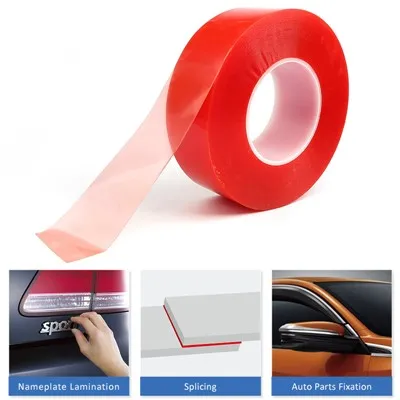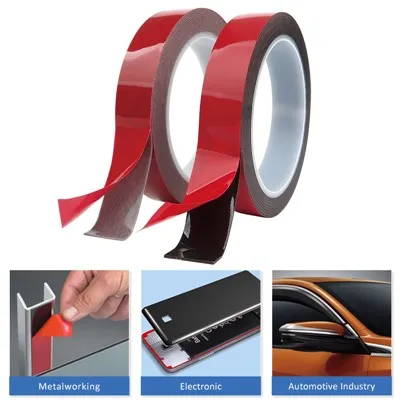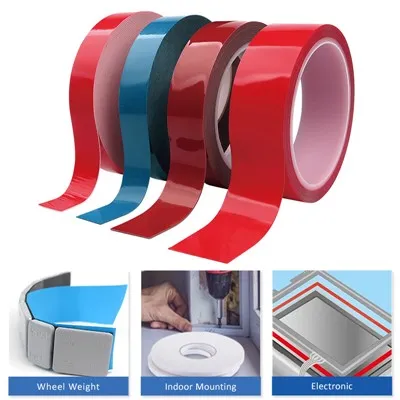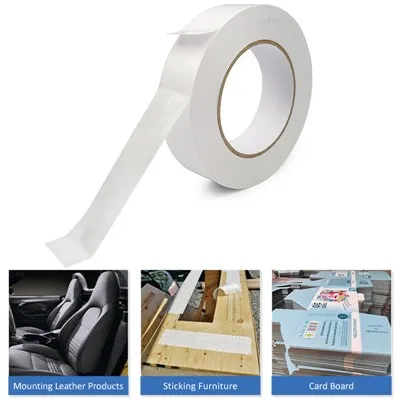
In today's industrial manufacturing, electronic assembly, and daily consumer goods, double-sided PET tape plays an increasingly critical role as a high-performance bonding solution. With its unique material properties and wide application adaptability, it has become an indispensable auxiliary material in many industries.
Double-sided PET tape is a tape-shaped adhesive material made of PET film as the base material and double-sided coating of high-performance pressure-sensitive adhesives (such as acrylic adhesives, rubber adhesives, etc.).
Outstanding features and advantages of double-sided PET tape:
Excellent mechanical properties: The PET base material gives the tape high tensile strength, tear resistance, and dimensional stability.
Good temperature resistance: It can usually withstand temperatures from -20°C to 120°C or even higher (depending on the specific adhesive and thickness).
Excellent weather resistance and chemical resistance: It resists UV rays, moisture, and corrosion from various solvents and greases, and has a long service life.
Electrical insulation: PET itself is a good insulator and is suitable for the electronic and electrical fields.
Thin and uniform thickness: Ultra-thin design (such as 0.025mm) can be achieved to meet precision assembly needs.
Good transparency: Most double-sided PET tapes have high transparency and do not affect the appearance.
Stable bonding performance: Provides a reliable balance of initial adhesion, holding force, and peeling force.
No residue/clean removal: High-quality adhesive design can reduce or avoid residual adhesive during removal.
Main application areas of double-sided PET tape
Electronic and electrical industry (core application):
Smartphone/tablet/computer: screen fixation, battery bonding, camera module assembly, FPC/PCB temporary fixation, component shielding, label pasting, etc.
Home appliances: control panel assembly, nameplate pasting, internal wiring harness fixation, and insulation material bonding.
LED lighting: LED light bar fixation, lens bonding, heat sink installation.
Automotive manufacturing and interior:
Interior parts assembly: bonding and fixing of decorative strips, panels, logos, carpets, and sound insulation cotton.
Harness fixation: Bundling and fixing of wires and cables.
Sensor installation: Bonding of sensors such as radars and cameras.
Lightweight material bonding: Connection of composite materials and plastic parts.
Industrial manufacturing:
Nameplate and label pasting: On metal, plastic, glass, and other surfaces.
Plastic/metal parts assembly: Replace screws or welding to achieve seamless connection.
Film/sheet fixing: Such as temporary fixing before lamination of solar panels.
Surface protection: Surface protection of precision machined parts during transportation and processing (usually using low-viscosity PET tape).
Building and home:
Decorative material installation: Bonding of mirrors, hooks, lightweight picture frames, skirtings, etc.
Temporary fixation of glass: Auxiliary positioning during construction.
How to choose the right double-sided PET tape?
Choosing the right double-sided PET tape is crucial, and the following key factors need to be considered:
Bonded material: What is the bonding surface? (Plastic PP/PE/ABS/PC/PMMA? Metal? Glass? Wood? Fabric?) Different material surfaces can require different types of adhesives.
Bond strength requirements: How strong is the initial adhesion (quick fixation) and the lasting adhesion (long-term shear resistance)? Peel force requirements?
Use environment:
Temperature: Maximum/minimum working temperature? Is there a temperature shock?
Humidity/chemical environment: Is it exposed to water, oil, or solvent?
Outdoor/indoor: Is UV aging resistance required?
Stress type: Is it mainly static load or dynamic vibration?
Thickness requirement: How thick is the tape needed to fill the gap or provide a buffer? Ultra-thin application?
Electrical performance: Is insulation required? Insulation level requirements?
Appearance requirements: Is it required to be transparent? Color requirements?
Removal requirements: Is it required to be removable or reworkable? Is residual glue allowed after removal?
Key points for the use and storage of double-sided PET tape
Surface treatment: Make sure the surface to be bonded is clean, dry, and free of oil, dirt, and dust. Wipe or use a treatment agent if necessary.
Pressure: Apply uniform and sufficient pressure (such as rolling) after bonding to ensure that the tape is in full contact with the bonded surface.
Time: It usually takes a certain amount of time (24-72 hours) to reach the final bonding strength, and avoid excessive load during this period.
Storage: Store in a cool and dry place (recommended 23±5℃, 50±10%RH), avoid direct sunlight and heavy objects. Pay attention to the protection of the release paper/film.