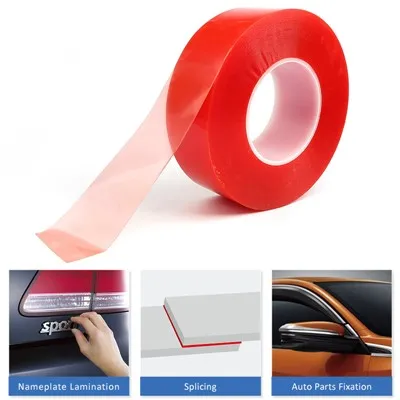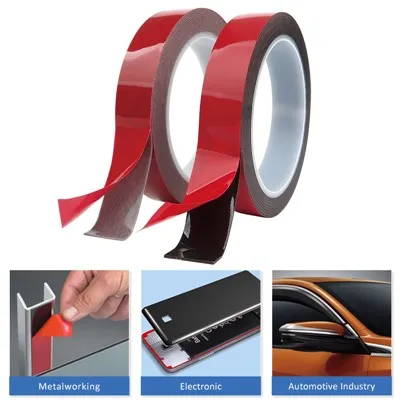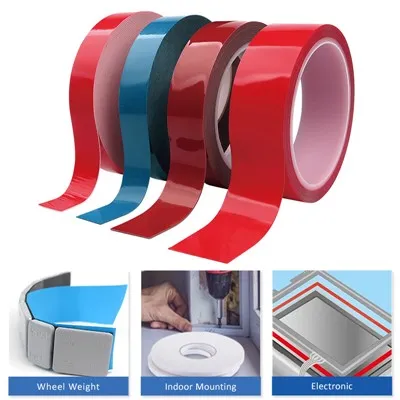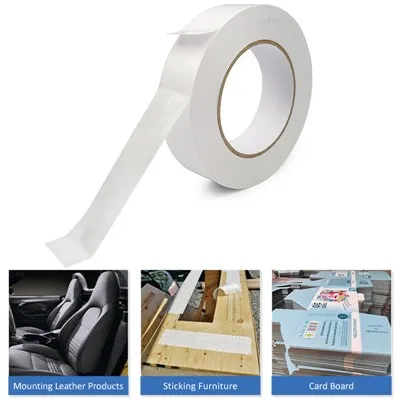
In the context of modern electronic products trending towards "light, thin, and sophisticated," traditional mechanical fastening methods (such as screws and clips) have gradually been replaced by high-performance adhesive technologies. Among these, double-sided PET tape has become the "invisible skeleton" of smartphones, tablets, and wearable devices, thanks to its excellent dimensional stability and physical strength.
The key role of PET tape in the electronics industry:
Precision Bonding of Structural Components
In the extremely compact internal space of electronic products, PET tape is often used as the main bonding medium to fix display modules (LCD/OLED), back panels, and middle frames together.
Compared to unsupported tapes, the PET substrate prevents stretching and deformation during automatic assembly, ensuring assembly accuracy of 0.01mm.
Battery Fixation and Safety Protection
In lithium battery assembly, PET tape is responsible not only for fixing the battery in the casing but also for insulation and impact resistance.
It must possess excellent shear strength to prevent battery displacement during device drops, which could lead to fire.
Mentioning PET tape that meets the UL 94V-0 flame-retardant standard would significantly enhance the credibility of the content.
Light Blocking and Optical Management
In backlight modules (BLU), black PET double-sided tape is indispensable.
It acts as a barrier to prevent light leakage while simultaneously fixing the reflector and light guide plate.
Extremely high optical density (OD value > 5.0) and low outgassing prevent contamination of optical components.
Insulation and Shielding of Electronic Components
Since PET (polyethylene terephthalate) itself is an excellent insulator, it is often used to cover printed circuit boards (PCBs) or flexible printed circuits (FPCs).
Application scenario: Bonding graphite sheets or copper foil to heat sources, achieving both heat dissipation and electrical insulation. 5. Cushioning & Shock Absorption
Although PET tape itself is very thin, by compounding it with special adhesives, it can effectively absorb the micro-vibrations of electronic devices during daily use.
This solves the problem of loosening or noise (Buzz, Squeak, and Rattle) in electronic components under long-term vibration.
Cornerstone of Die-cutting Processability:
For processors, the "processability" of PET tape is its greatest advantage.
The substrate has high rigidity, resulting in clean edges during high-speed stamping without burrs or adhesive overflow.
Common ultra-thin PET tapes can be as thin as 0.005mm, a processing limit that is difficult for other substrates to achieve.
How to choose the right PET tape for electronic products?
When evaluating electronic-grade PET tape, it is recommended to focus on the following three technical dimensions:
Surface energy matching:
Different acrylic adhesive systems are required for ABS, PC, or metal materials.
Temperature resistance curve:
Can it withstand the high temperature test of reflow soldering?
Environmental compliance:
Has it passed RoHS 2.0 and HF (halogen-free) certification?
Electronic product failures often stem from minor bonding problems. Before mass production, it is essential to conduct complete 180° peel tests and constant temperature and humidity aging tests.