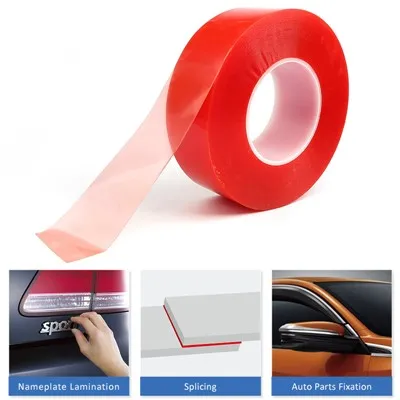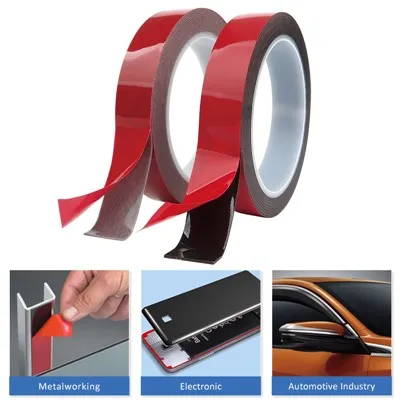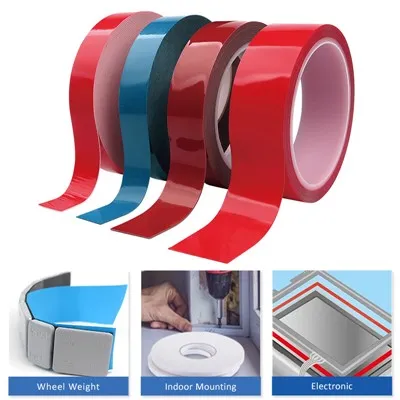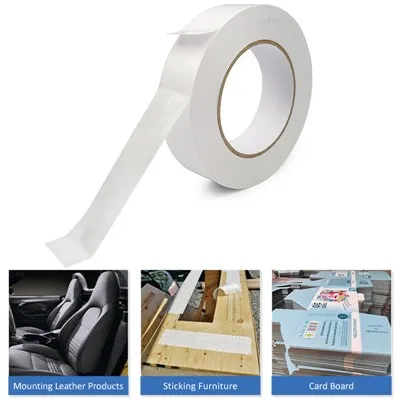
In industrial assembly, automotive manufacturing, and building facades, acrylic foam tape has become the preferred alternative to mechanical fasteners (such as rivets and welding). However, a common question for many buyers is: "It looks similar to ordinary double-sided tape, so why is it more expensive and performs better?"
What is Acrylic Foam Tape?
An adhesive method made completely of acrylic is called acrylic foam tape. In contrast to conventional tapes, which have a clear "substrate + adhesive layer" construction, superior acrylic foam tape usually demonstrates "viscoelasticity." In other words, the tape serves as both the foam substrate and the adhesive. When under pressure, it moves like a fluid to moisten the surface; when under tension, it absorbs energy and reverts to its initial form like an elastic solid.
A Comprehensive Comparison of Acrylic Foam and Regular Double-Sided Tape
| Typical | Double-Sided Tape (such as cotton paper or PET substrate) | Acrylic Foam Tape |
| Core Material | Rubber or a thin layer of acrylic adhesive + carrier | 100% closed-cell acrylic foam |
| Stress Distribution | Concentrated on the surface of the adhesive layer, easily torn | Stress is distributed throughout the entire thickness, with a strong load-bearing capacity |
| Weather Resistance | Prone to yellowing, easy to ooze/dry out at high temperatures | Excellent UV resistance, high temperature resistance, and chemical resistance |
| Sealing Performance | Only provides adhesion, no waterproof sealing function | Closed-cell structure provides permanent waterproof sealing |
| Shock Absorption and Noise Reduction | Very thin, no cushioning effect | Excellent viscoelastic shock absorption, absorbs mechanical vibrations |
Why is Acrylic Foam Tape a superior choice?
100% Closed-Cell Structure: More than just adhesion
Ordinary foam (such as sponge) is open-cell, allowing moisture to penetrate. Acrylic foam uses a closed-cell structure. This means that while bonding two objects, it also acts as a permanent waterproof and airtight gasket.
Experts in handling thermal expansion and contraction
In automotive interior or outdoor curtain wall applications, different materials (such as metal and plastic) have different coefficients of thermal expansion. Ordinary tapes can become brittle and detach under temperature changes, but AFT, with its viscoelastic properties, can stretch with the expansion and contraction of the materials, relieving stress concentration.
Initial tack vs. ultimate strength
Ordinary tape: Very sticky upon application, but performance may degrade over time.
AFT: Moderate initial tack, but under pressure, its strength increases over time (usually peaking at 72 hours), forming a strong bond similar to chemical welding.
Typical Application Scenarios
Automotive industry:
Fixing side moldings, emblems, and spoilers.
Construction engineering:
Reinforcing glass curtain walls and elevator door panels.
Electronic products:
Screen frame bonding, battery compartment fixing.
How to choose?
If you only need simple office bonding or short-term indoor fixing, ordinary double-sided tape is more cost-effective. However, if your application involves any of the following, acrylic foam tape is the only reliable option:
Exposure to the outdoors, sunlight, and rain;
Requires resistance to continuous dynamic loads or vibrations;
Requires a long-term bonding life (5-10 years or more);
Bonding two materials with different coefficients of thermal expansion.