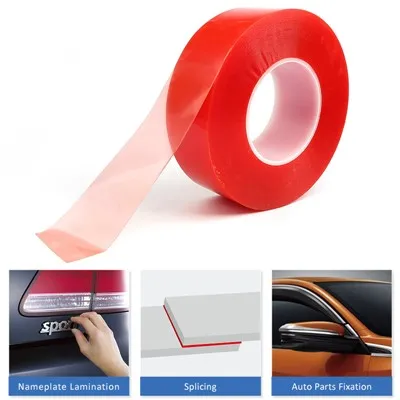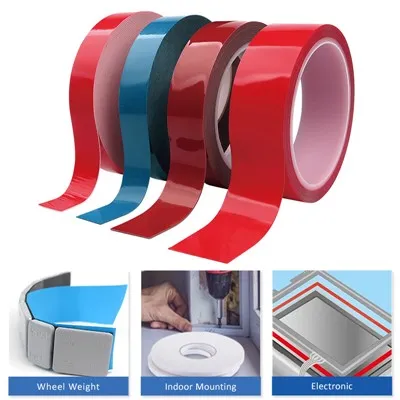
In precision industrial manufacturing, die-cutting accuracy directly determines the final product's yield rate. When it comes to bonding internal components in electronic devices, backlight modules, or medical instruments, engineers frequently specify the use of double-sided adhesive tapes with a PET (polyester film) substrate.
Four Core Advantages of PET-Substrate Tapes in Die-Cutting Processes
1. Exceptional Dimensional Stability:
Instantaneous pressure release and high-frequency stamping are used in the die-cutting process.
In contrast, Unsupported adhesive tapes (without a substrate) have a fluid-like viscosity, analogous to "jelly." Cotton paper substrates are made of randomly oriented fibers, which makes them vulnerable to minute stretching or displacement when subjected to force.
The Performance of PET: PET film has a very high modulus and tensile strength. This indicates that the tape does not distort under mechanical force during the stamping stroke. With dimensional tolerances usually adjustable within ±0.05 mm, the die-cut parts' dimensions attain a high degree of consistency with the mold design parameters.
2. Superior Cutting Efficiency (Clean Cutting Edge):
A crucial indicator of die-cutting quality is "edge cleanliness."
The advantage of hardness is that PET is a reasonably stiff film. The PET substrate offers the structural support required to enable a "brittle fracture" as the cutting die descends, guaranteeing that the substrate and adhesive are both neatly "sheared" rather than just "squeezed" apart.
Preventing Adhesive Oozing: The outward extrusion (oozing) of adhesive at the cut edges is efficiently suppressed by the PET substrate's inherent stiffness. PET is the only substrate material that can provide minimal adhesive oozing and prevent undesired adhesion to the release liner when die-cutting ultra-narrow strips (such as adhesive strips that are only 0.5 mm wide).
3. Structural Support and Waste Removal Efficiency (Stripping and Weeding):
The "waste removal" (weeding) step following die-cutting is a critical factor in overall production efficiency.
Tensile Strength: PET substrates possess exceptional tensile strength in both the longitudinal and transverse directions. During automated waste removal processes, the surrounding waste matrix (the scrap material) must be continuously pulled away.
Benefits: PET tape's waste matrix is far more durable than tissue tapes, which are prone to tearing. It greatly reduces the amount of downtime needed for maintenance and repairs since it can withstand the tensile pressures applied by high-speed automatic waste-removal machines without breaking.
4. Thickness, Consistency, and Flatness:
High-precision die-cutting demands that the tape itself possess extremely uniform thickness.
Precision Coating: PET film is manufactured via an extrusion process, resulting in a surface with exceptional flatness.
This substrate can be coated with an adhesive to produce a very consistent dry adhesive thickness.
Physical Parameters: PET tapes usually come in a variety of exact thickness options, from 5μm to 200μm. This consistency in thickness is the essential foundation for guaranteeing the finished device's overall assembly precision for precision electronic components involving multi-layer stacking.
Technical Comparison Table: Performance of Different Substrates in Die-Cutting
| Performance Dimension | PET Substrate (Polyester) | Tissue Substrate | Linerless (Transfer) |
| Die-Cutting Precision | Extremely High | Moderate | Lower (Prone to Deformation) |
| Edge Cleanliness | Crisp, Burr-Free | Prone to Fiber Burrs | Prone to Adhesive Squeeze-out |
| Waste Removal Difficulty | Extremely Easy (High Strength) | Moderate (Prone to Breaking) | Extremely Difficult |
| Thickness Tolerance | ±3% - 5% | ±10% | ±10% |
How to Further Enhance PET Die-Cutting Precision?
As a professional adhesive supplier, we recommend that die-cutting facilities pay close attention to the following two points when processing PET tapes:
Release Force Matching:
Ensure that the peel force of the release liner (whether light or heavy release) remains stable. Excessive fluctuation in release force can cause small die-cut parts to "jump" or "drift" off the liner after cutting.
Tool Selection:
Given the relative hardness of PET, we recommend using high-grade steel blades with a mirror finish or tungsten carbide dies. Additionally, the cutting edges should be inspected regularly for wear to prevent the formation of minute white edges or powdery residue.
In today's era-characterized by the pursuit of miniaturization and precision-PET double-sided tapes have become a cornerstone of the die-cutting industry, thanks to their irreplaceable physical stability. If you are currently designing precision electronic components, PET tape serves as a powerful assurance of high production yields.