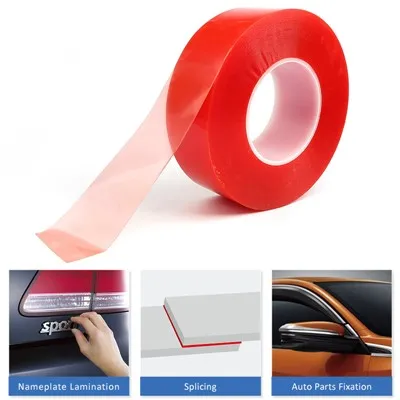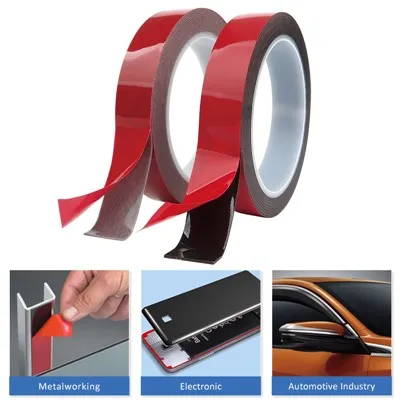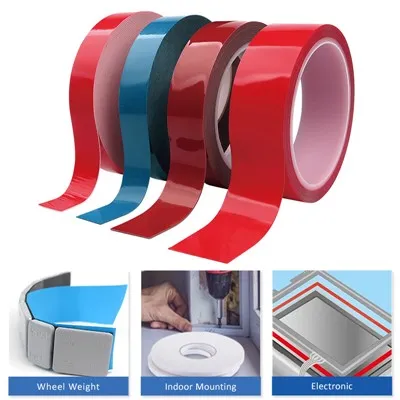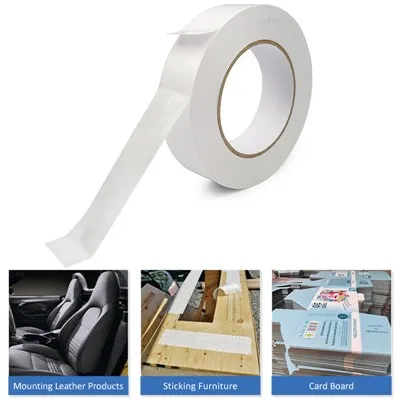
In the adhesive products industry, there is a seemingly counterintuitive phenomenon: quite often, that thin-almost invisible-layer of linerless double-sided tape (known as Adhesive Transfer Tape) exhibits stronger and more reliable adhesion than tapes featuring a central layer of paper or plastic film.
Why does the adhesive perform better without a supporting "skeleton"?
This isn't some form of "black magic" technology; rather, it is determined by the physical principles of "wettability" and "stress distribution."
The Ultimate "Wetting": Allowing the Adhesive to Truly Bond with the Surface
The thickness of the tape is the main determinant of the adhesion, not the ability of the adhesive to touch the surface of the object.
Tapes with a Carrier: Whether it's cotton paper, PET film, or foam, acts like a "rigid wall. " When the surface features microscopic irregularities, this rigid wall restricts the flow of the adhesive. Consequently, the adhesive can only make contact with the "peaks" of the surface topography, failing to reach the "valleys."
Linerless Tapes: These are, in essence, pure "liquid films." Under application pressure-and unhindered by any central layer-the adhesive flows like water, filling every microscopic groove and recess on the surface.
In physics, this phenomenon is known as "wetting." As the contact area increases, the intermolecular Van der Waals forces naturally multiply exponentially.
Eliminating "Internal Stress": Adapting Seamlessly to Any Environment
Many tape detachments occur because the tape is "trying too hard to spring back into its original shape," not because the adhesive itself lacks tackiness.
The issue with carriers is that the central film, particularly PET or rigid films, produces an outward-pulling restorative force when you apply tape to a curved surface with a carrier layer. The adhesive is constantly tugged on by this force for a 24-hour period, eventually leading to the removal of the adhesive's edges.
The Benefit of Linerless Tapes: They don't have a carrier layer, hence they have no "shape memory." They will hold the shape you give them during application. In fact, this state of "complete neutrality" produces an extraordinarily strong bond since it produces no internal stress to operate against the bonding surfaces.
Enhanced "Energy Absorption" Capability
When subjected to external impact or tensile forces, transfer adhesive tapes behave more like a unified, monolithic entity.
With supported adhesive tapes, stress tends to concentrate at the "adhesive-substrate" interface when under load. This frequently results in "delamination, "a situation where the backing film adheres to the object but the adhesive stays adhered to the object. Conversely, Transfer tapes evenly distribute this stress throughout the adhesive layer's entire thickness. The tape is exceptionally tough when resisting shear forces thanks to this pure-adhesive film structure.
When Should You Choose Double-Sided Transfer Tape?
While it boasts strong adhesion, it is not a universal solution. Its optimal applications include:
Extremely Tight Spaces:
Where adding any extra thickness is strictly prohibited, such as bonding mobile phone screens or electronic components.
Metal Nameplates and Panels:
Applications requiring high-temperature resistance and long-term shear strength to prevent the nameplate from sliding or detaching.
Precision die-cutting:
Creating intricate shapes with the tape without leaving fibrous burrs along the edges.
Bonding Transparent Components:
True, optical-grade transparency can be achieved by removing an intermediate backing layer.
Double-Sided transfer Tape has a "strength" that is related to the choices it makes to forgo. By shedding its structural backing, it gains the opportunity for a truly intimate, "soul-level" bond with the surface it adheres to.
If you are working on a project involving flat surfaces that demands ultra-thin profiles and long-term tensile resistance, do not be deceived by the illusion of its slender form. In the world of adhesives, sometimes "nothing" truly beats "something."