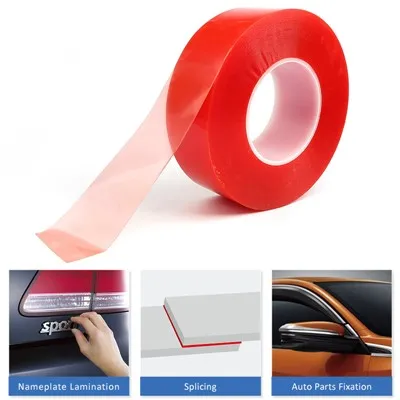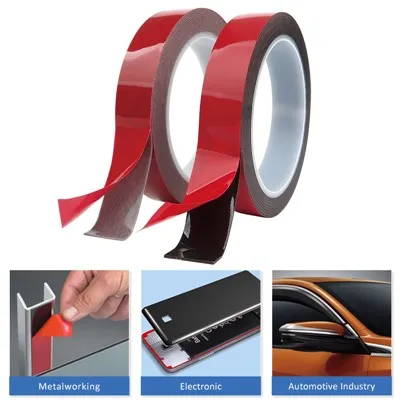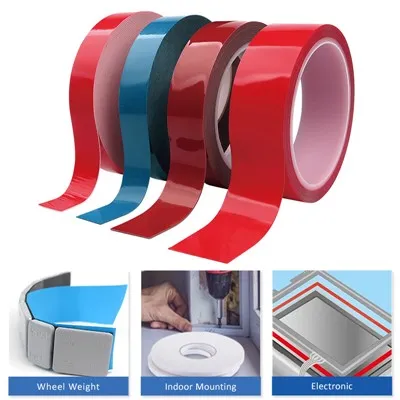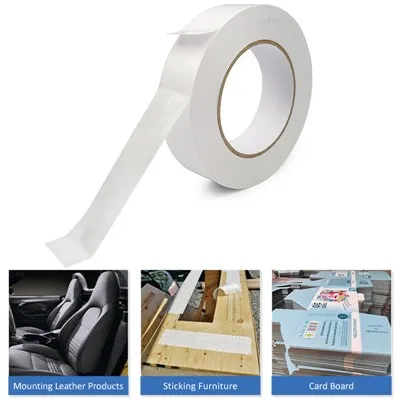
In the industrial adhesive field, double-sided transfer tape is often referred to as a "pure adhesive." Compared to traditional double-sided tapes with a substrate, it is extremely simplified in structure but exceptionally powerful in performance.
What is a "substrate-free" design?
Most people are familiar with double-sided tapes that have a central carrier (such as PET film, non-woven fabric, or foam), but transfer tape eliminates this layer.
Naikos double-sided transfer tape consists of a transparent acrylic adhesive, coated with a release liner. It is a popular choice for graphic attachment and general industrial joining applications. It provides outstanding adhesion to metals and high-surface-energy plastics. This adhesive provides some initial repositionability for placement accuracy when bonding top plastics.
How does it achieve secure bonding?
The core of the transfer tape's function lies in the viscoelastic properties of the transparent acrylic adhesive. It completes the transformation from "tape" to "structural fixation" through the following three stages:
Initial Contact and "Wetting Out"
Due to the absence of rigid constraints imposed by a physical substrate (such as PET film), transfer tape exhibits excellent fluid characteristics. When pressure is applied, the adhesive flows like an extremely slow liquid, "filling" the microscopic depressions and irregularities on the surface of the object being bonded. This thorough physical contact is called "wetting out," and it is the foundation for strong adhesion.
Intermolecular Forces
When the adhesive layer and the surface reach atomic-level proximity, Van der Waals forces (intermolecular attractive forces) begin to act. Although the attractive force between a single pair of molecules is weak, billions of contact points combine to create powerful peel strength.
Viscoelastic Transformation
Transfer tape behaves like a liquid under pressure (filling gaps) and like a solid when subjected to tensile or shear forces (resisting displacement).
Why do engineers choose transfer tape?
Ultra-thin:
Achieves adhesive thicknesses as low as 0.05mm (2 mil) or even thinner, which is crucial for electronic products with limited internal space, such as smartphones and tablets.
Excellent Die-cutting Precision:
The absence of a substrate means that during high-speed die-cutting, there is no stretching or delamination of the substrate edges, resulting in clean and smooth cut edges.
Superior Conformability:
It conforms to curved, arched, or uneven surfaces. Tapes with a substrate often experience "pop-off" due to the substrate's "physical memory," while transfer tapes conform perfectly.
Expert Application Recommendations
As industrial adhesive experts, we recommend following these standard operating procedures when applying transfer tapes to ensure reliability:
Surface Tension Matching:
Not all surfaces are easily bonded. For low surface energy (LSE) materials such as polypropylene (PP) or Teflon, a specialized modified acrylic adhesive must be selected, or a primer should be used.
The Importance of Pressure:
"Pressure-sensitive" tapes require pressure activation. Using a pressure roller or automated press is recommended to ensure at least 15-20 psi of pressure is applied to expel air and promote wetting.
Dwell Time:
Bonding is a dynamic process. At room temperature, it typically takes 72 hours to reach 100% of the final bond strength. If acceleration is needed, heating (approximately 50°C to 65°C) can be applied.