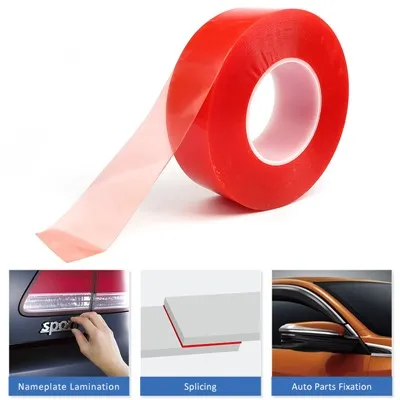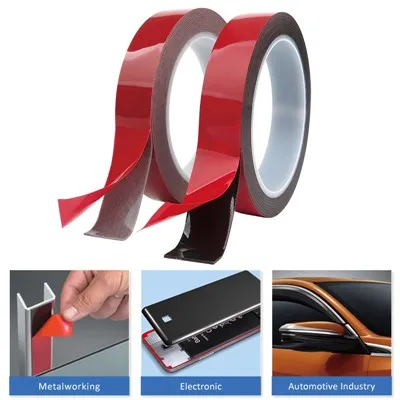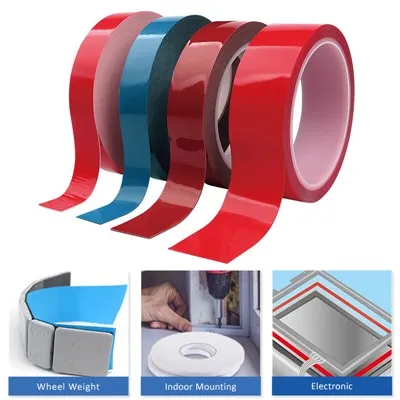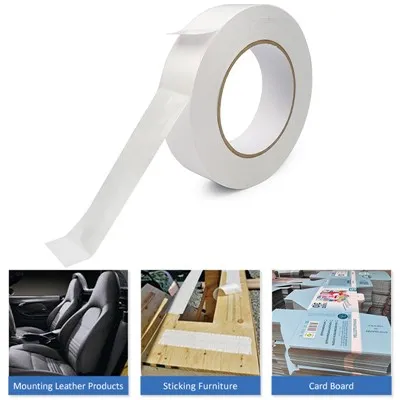
This guide explains the main factors engineers, OEM purchasing teams, and product designers should evaluate before specifying acrylic foam tape for automotive trim, appliance assembly, signage, electronic housings, and other industrial bonding applications.
In This Guide
- Understand how acrylic foam tape works
- Define the bonding requirements
- Check substrate compatibility
- Choose the appropriate tape thickness
- Prepare the bonding surfaces
- Evaluate temperature and environmental conditions
- Review joint design and load direction
- Identify common bonding problems
- Consider customized converting solutions
- Use the selection checklist
- Frequently asked questions
Understand How Acrylic Foam Tape Works
Acrylic foam tape is a pressure-sensitive adhesive tape that uses an acrylic foam layer to bond two surfaces. Depending on the construction, the foam layer can conform to minor surface irregularities and accommodate some movement between assembled components.
These characteristics make acrylic foam tape a practical option for selected applications where manufacturers need a distributed bonding area, a clean appearance, or an alternative to some mechanical fastening methods. Its suitability still depends on the materials being joined and the loads expected in service.
Acrylic foam tape is different from conventional double-sided tissue or film tape because the foam carrier contributes to the construction and deformation behavior of the bonded joint. For a comparison of tape structures and typical uses, see our guide on how acrylic foam tape differs from ordinary double-sided tape.
You can also review our range of acrylic foam tape products to identify possible constructions for your assembly requirements.

Define the Bonding Requirements Before Choosing a Tape
Start by defining what the tape must do in the finished product. A tape used to attach a lightweight decorative trim may require a different balance of conformability, holding performance, and environmental resistance than one used to secure an exterior automotive component.
Bonded materials
Identify both substrates, including their exact material grades, coatings, paint systems, surface textures, and any release agents or protective finishes.
Load and joint design
Determine the component weight, contact area, load direction, vibration exposure, joint movement, and any sustained or intermittent forces.
Application process
Record application temperature, available pressure, assembly time, production speed, and the interval before the bonded part is loaded.
Service conditions
Consider operating temperature, humidity, UV exposure, water contact, cleaning agents, chemicals, and the required service life.
These details help narrow the selection to constructions that can be tested under realistic conditions rather than relying on a general-purpose specification.
Check Substrate Compatibility
The two bonding surfaces are among the most important variables in acrylic foam tape selection. Two components that look similar may bond differently because their surface energy, coating, texture, or manufacturing residues are different.
| Substrate category | What to check | Recommended evaluation |
| Painted or coated metal | Paint chemistry, coating adhesion, surface texture, and curing condition | Test the complete coating system, not only the underlying metal |
| Aluminum and stainless steel | Surface finish, contamination, oxidation, and cleaning process | Compare bonding results across representative production surfaces |
| ABS and other plastics | Plastic grade, additives, mold release agents, and surface energy | Confirm adhesion on the exact resin and molded finish |
| Low-surface-energy plastics | Material type, surface treatment, and formulation compatibility | Conduct application-specific testing and assess whether pretreatment is needed |
| Glass and rigid panels | Cleanliness, surface condition, panel movement, and joint geometry | Evaluate actual panel dimensions, loads, and environmental exposure |
If the assembly uses multiple substrates, test the tape on both surfaces. Either interface can limit the bond, and a strong bond to one component does not guarantee a strong bond to the other.
For applications with higher bonding demands, consider very high-bond acrylic foam tape for technical evaluation. Final suitability must be confirmed against the actual materials and loading conditions.
Choose the Appropriate Acrylic Foam Tape Thickness
Tape thickness affects the way a bonded joint accommodates gaps, surface irregularities, and movement. The thickest tape is not automatically the best option. The correct choice depends on the geometry of the parts and the amount of deformation expected after assembly.

When evaluating thickness, consider:
- Surface flatness: More uneven surfaces may require a construction with greater conformability.
- Gap variation: Measure the real gap across the bonding area rather than relying on a single measurement.
- Component movement: Consider thermal expansion and movement between dissimilar materials.
- Edge geometry: Narrow bonding areas and edges exposed to peel forces require careful joint design.
- Compression during assembly: Confirm that the chosen tape can achieve the required contact without creating unwanted stress.
For assemblies requiring a specified tape construction and performance balance, review high-performance acrylic foam tape and compare the current technical data sheet with your design requirements.
Prepare the Bonding Surfaces Correctly
Even a suitable acrylic foam tape can perform poorly if the bonding surfaces are contaminated or the application process is inconsistent. Dust, oil, moisture, polishing compounds, mold release agents, and some coating residues can interfere with adhesive contact.
Recommended preparation steps
- Inspect the substrate. Check for loose coatings, visible contamination, condensation, and surface damage.
- Use a compatible cleaning method. Select a cleaning agent that is suitable for the substrate and follow the relevant workplace safety instructions.
- Allow the surface to dry. Do not apply tape over residual solvent or moisture unless the specific process has been validated.
- Apply the tape with controlled pressure. Ensure contact across the intended bonding area and avoid trapped contamination.
- Follow the specified dwell and loading conditions. Avoid assuming that the assembly reaches its intended performance immediately after application.
Surface preparation methods must be compatible with the actual material. Solvents can damage some plastics or finishes, so a cleaning procedure should be tested before production use.
For more guidance on application and handling, read precautions for using acrylic foam tape.
Evaluate Temperature and Environmental Conditions
A tape that performs well during initial assembly may behave differently after exposure to heat, cold, moisture, sunlight, or chemicals. These conditions can affect the adhesive, the foam layer, the substrate surface, or the integrity of the overall joint.
Temperature cycling
Evaluate the lowest and highest service temperatures, the duration at each temperature, and repeated heating and cooling. Dissimilar materials may expand at different rates.
Moisture and outdoor exposure
Consider humidity, water exposure, UV radiation, and the possibility of moisture entering through exposed edges or an imperfect joint.
Chemical contact
Check exposure to cleaners, oils, fuels, process chemicals, or other substances that may be present during manufacturing or service.
Long-term loading
Evaluate sustained loads, vibration, component movement, and the required service life using representative testing conditions.
Request current technical documentation for the specific tape grade under consideration. Published test values should be interpreted alongside the test method, substrate, dwell time, and environmental conditions; they should not be treated as universal guarantees for every application.
Review Joint Design and Load Direction
Adhesive performance depends on how forces are transferred through the joint. A design that distributes force over a broad bonding area may behave differently from one that concentrates force at a narrow edge.
Design factors to review
- Bonding area: Confirm that the available area is sufficient for the expected load and the required safety margin.
- Peel exposure: Avoid joint geometries that repeatedly lift or pull the tape edge away from the substrate.
- Stress distribution: Where practical, design the joint to distribute loads instead of concentrating them at one point.
- Material expansion: Allow for movement between substrates with different thermal expansion characteristics.
- Production tolerances: Check alignment, component variation, and the repeatability of the assembly process.
Acrylic foam tape may be suitable for trim attachment, nameplates, signs, selected appliance components, and other bonding tasks. For safety-critical, structural, or heavily loaded applications, verify the design with application-specific engineering tests and any applicable industry requirements.
Identify Common Acrylic Foam Tape Bonding Problems
When a bonded assembly fails, changing to a tape with a higher advertised strength is not always the correct first step. Examine the failure mode to identify whether the issue comes from the substrate, application process, tape selection, or joint design.
| Observed problem | Possible cause | What to investigate |
|---|---|---|
| Edge lifting | Peel stress, poor contact, contamination, or incompatible substrate | Review edge design, surface preparation, pressure, and substrate compatibility |
| Component slips under load | Insufficient holding performance, premature loading, or unsuitable joint design | Check load direction, bonded area, dwell time, and application-specific test data |
| Inconsistent results between batches | Variation in surface condition, tape handling, pressure, or production parameters | Standardize preparation and application procedures and document process settings |
| Bond weakens after environmental exposure | Temperature, moisture, chemicals, or movement beyond the validated conditions | Reproduce the service environment during testing and reassess material compatibility |
| Adhesive transfers or residue remains | Substrate interaction, aging, removal conditions, or an unsuitable tape construction | Review the failure surface, service duration and removal requirements |
Record the failed component, tape grade, lot information, application conditions, and service history. This information helps distinguish an adhesive-interface failure from a substrate-coating failure or a joint-design problem.
Consider Custom Acrylic Foam Tape Converting
Standard tape rolls are not always the most efficient format for OEM assembly. Depending on the design and tape construction, converting can supply the required width, length, shape, or liner arrangement for the production process.
- Slitting: Match tape width to the available bonding surface or assembly equipment.
- Die-cutting: Produce repeatable shapes for trim, nameplates, panels, and other components.
- Liner customization: Evaluate liner handling and release requirements for manual or automated application.
- Roll format customization: Specify roll length and dimensions based on storage, dispensing, and production needs

Review our custom die-cut acrylic foam tape options if your assembly requires a specific geometry or converting format. For broader converting requirements, see our die-cutting service.
To help evaluate a custom solution, provide a drawing or sample, substrate details, target dimensions, operating conditions, and estimated order volume. These inputs make it easier to assess technical feasibility and quotation requirements.
Acrylic Foam Tape Selection Checklist
Before approving a tape for production, confirm that the following information has been reviewed by the engineering, quality, and purchasing teams as applicable.
Pre-qualification checklist
- Both bonding substrates and their surface finishes have been identified.
- The required bonding area, joint geometry and load direction are defined.
- Tape thickness and construction have been selected for the actual assembly.
- Surface cleaning and application pressure are documented.
- Application temperature and required dwell time are specified.
- Operating temperature, moisture, UV and chemical exposure have been assessed.
- Current technical data and relevant test methods have been reviewed.
- Representative samples have been tested on the actual production materials.
- Custom converting dimensions and production tolerances are confirmed if needed.
A sample evaluation should reproduce the real bonding surfaces and the important steps in the manufacturing process. Where service conditions are demanding, include appropriate aging or environmental testing before releasing the tape for production.
Frequently Asked Questions
Q1. How do I choose the right thickness of acrylic foam tape?
Choose thickness according to the gap between the parts, surface flatness, component geometry, required conformability and expected movement. Validate the selected thickness on the actual assembly rather than choosing by thickness alone.
Q2. Does acrylic foam tape bond to plastic and metal?
Acrylic foam tape can be used on many metal and plastic surfaces, but performance depends on the specific substrate, surface energy, finish, cleanliness and adhesive formulation. Test the actual material combination before production, especially when coatings or low-surface-energy plastics are involved.
Q3. Why does acrylic foam tape sometimes peel off?
Common causes include contamination, poor substrate compatibility, insufficient application pressure, inadequate adhesive contact, unsuitable tape selection, premature loading and peel forces caused by joint design. Inspect the failure surface and reproduce the application conditions to identify the cause.
Q4. Can acrylic foam tape be die-cut into custom shapes?
Yes. Acrylic foam tape can be converted into custom shapes and dimensions for suitable applications. Die-cutting feasibility depends on tape construction, thickness, tolerances, liner, and assembly requirements.
Q5. How can I verify whether an acrylic foam tape is suitable for my application?
Review the technical data sheet and test the tape on the actual substrate under representative application, dwell, temperature, humidity and load conditions. Confirm suitability through application-specific validation before production approval.
Q6. What information should I provide when requesting a tape recommendation?
Provide the substrate materials, surface finish, bonding dimensions, service temperature, environmental exposure, expected loads, application method, and estimated order volume. Drawings, photos, and physical samples can also help evaluate a custom solution.
Need Help Selecting Acrylic Foam Tape?
Naikos supplies adhesive tape solutions for industrial and OEM applications. Share your substrate details, assembly requirements and target specifications to discuss suitable tape constructions, converting options and sample evaluation.
Technical note: General selection guidance does not replace application testing. Actual bonding performance depends on the tape grade, substrate, surface preparation, assembly process and service environment. Confirm specifications and suitability with current technical documentation and representative testing.