In the automotive painting and detailing industry, regular crepe paper is sufficient for large-area masking needs. However, when dealing with two-tone paint jobs, pinstriping, or multi-curved contours, fine line tape is an indispensable professional tool.
The Core Definition and Material of Fine Line Tape
Unlike the paper-based substrate of regular masking paper, fine line tape typically uses a film substrate (such as PVC or polyethylene). It is extremely thin, and the adhesive is specially formulated to provide exceptional clarity and minimal edge build-up.
Comparison of Fine Line Tape and Regular Masking Tape
| Characteristics | Regular Masking Tape | Fine Line Tape |
| Substrate | Crepe paper (limited flexibility) | PVC/film (high elasticity) |
| Paint Edges | Slightly rough, jagged | Extremely sharp, smooth |
| Impregnation Resistance | Medium, solvents may penetrate | Extremely strong, completely blocks solvents |
| Radius of Curvature | Only suitable for straight lines or large arcs | Easily handles S-curves and sharp angles |
4 Core Roles of Fine Line Tape in Automotive Detailing and Painting
A. Creating a Perfect "Zero-Step" Boundary Line
The "paint layer step" that remains after the tape is removed is the most difficult when painting two-tone automobile bodies. Fine line tape enables for a seamless paint transition, preventing heavy build-up at the borders and producing a factory-like paint finish because it is incredibly thin (usually between 0.1 and 0.13 mm)
B. Outstanding Flexibility and Adaptability to Intricate Curves
Wheel rims, rearview mirrors, and car bumpers frequently have intricate geometries. Because of its exceptionally high stretchability, fine-line tape can stick firmly to body lines and ensure that there is no paint peeling or leaking at curves. It also prevents breakage or springback when stretched.
C. Superior Solvent Resistance and High-Temperature Resistance
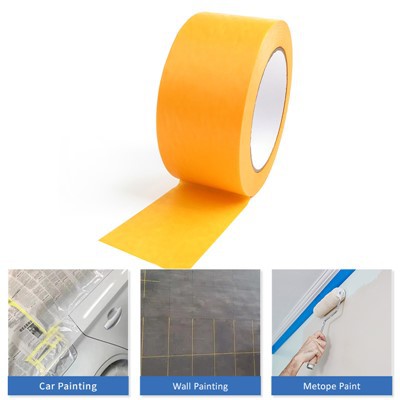
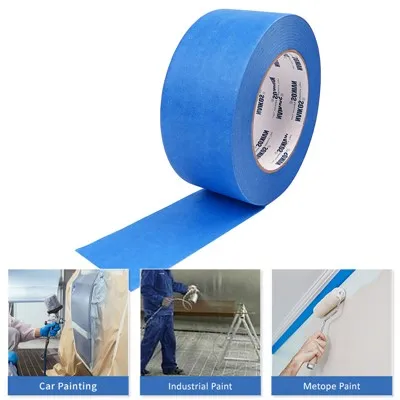
Professional automotive fine-line tapes (such as the commonly used blue or orange series) can withstand paint booth temperatures up to 130°C to 150°C. Even under prolonged immersion in solvent-based paints, the backing material will not penetrate, ensuring the masked area remains uncontaminated.
D. Clean Removal
This is key to distinguishing industrial-grade fine-line tape from cheaper alternatives. High-quality fine-line tape uses pressure-sensitive rubber/silicone adhesive, allowing for smooth peeling even from fresh paint after baking, leaving no adhesive residue and without tearing or damaging the primer.
How to Choose the Right Fine-Line Tape?
Check the width:
Common widths are 3mm, 6mm, and 12mm. 3mm is specifically designed for extremely fine line outlining and masking narrow gaps.
Check the color (industry standard):
Blue/Orange: Usually indicates high flexibility, suitable for handling complex 3D curves.
Green: Usually indicates higher hardness and straight-line stability, suitable for masking long-distance straight lines.
Check the technical parameters:
Check the Adhesion to Steel and Elongation at Break.
How to get the best results?
Clean the surface:
Thoroughly remove residual wax and grease with a degreaser before applying.
Avoid overstretching:
Although fine-line tape is elastic, overstretching will cause the tape to become thinner or shrink during baking.
Remove at a 45-degree angle:
After the paint has dried slightly, peel off at a uniform speed at an angle of 45 to 90 degrees to the painted surface for the sharpest edge. Fine-line tape is not just a masking tool, but also an "artistic touch" in fine automotive painting. If you're aiming for a custom car show-level finish, choosing a high-performance fine-line tape is crucial to success.