Many homeowners, beginners, and even some professional teams try to save money by utilizing regular white (or beige) masking tape when doing interior painting or construction improvements. Nevertheless, the final result is frequently catastrophic: removing the tape unintentionally removes the recently applied paint or leaves behind difficult-to-clean adhesive residue on glass surfaces.
Why is blue painter's tape so valuable, especially when it comes to painting walls?
Key Distinctions: 14-Day Clean Removal and UV Resistance
This is the main difference between regular white masking tape and blue painter's tape.
White Masking Tape:
Makes use of an adhesive made of natural rubber. Due to its great sensitivity to ultraviolet (UV) radiation, this glue quickly degrades chemically when exposed to sunshine or even UV rays that are refracted via windows. As a result, the glue effectively "bakes" itself onto the wall or glass surface and separates from its paper backing. As a result, it usually *must* be taken out within a day.
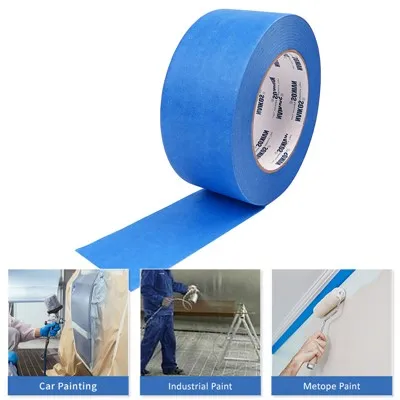
Blue Painter's Tape:
Uses a pressure-sensitive acrylic adhesive that has been carefully altered. This glue has remarkable UV stability; it can be removed with ease and cleanliness, leaving no adhesive residue behind, even after being applied to window frames exposed to direct sunshine for up to 14 or even 21 days.
Physical Properties: A Comparison of Paint Line Sharpness
The primary objective in wall painting is achieving a crisp, "razor-sharp" line where the wall meets the ceiling, or at the junction of two different paint colors.
Substrate Treatment:
A unique anti-penetration coating called "Sized Backing" is applied to the paper backing of blue painter's tape. This prevents the paint's moisture or solvents from penetrating the paper as you paint, which would otherwise weaken, rip, or lose its structural integrity.
Edge Sealing Technology:
Premium blue painter's tape has thinner, more accurately cut edges than regular masking tape.
It conforms tightly to the minute textures of the wall surface, effectively preventing paint "bleeding" (seepage) and thereby creating paint lines that appear as sharp and precise as if they were cut with a knife.
Adhesive Balance: Low Tack for Protecting Expensive Surfaces
Higher tack isn't always better.
Standard white masking tape is typically designed for industrial bundling applications and features high adhesion. If applied to a primed wall or wallpaper, the tensile force generated during removal can easily exceed the bond strength between the paint film and the wall surface, resulting in a "peeling" effect.
Blue masking tape undergoes precise physical calibration:
Peel Strength Control: Its peel strength is typically set within the range of 4–7 N/25mm (representing medium-to-low tack).
Application Logic: This specific tack level ensures the tape remains securely in place throughout the painting process while guaranteeing that-upon removal-it will not damage the underlying paint film or delicate decorative surfaces.
Quick Comparison Table: Technical Specifications
For ease of procurement and on-site reference, we have compiled the following table:
| Performance Metric | Standard White Masking Tape (General Purpose) | Blue Professional Masking Tape (For Painters) |
| Adhesive Type | Natural Rubber (Prone to degradation from heat) | Acrylic (Resistant to aging and light exposure) |
| Outdoor Weather Resistance | Very Poor (Recommended for indoor use only; avoid direct light) | Excellent (UV-resistant) |
| Recommended Maximum Application Time | < 24 Hours | 14 – 21 Days |
| Paint Line Quality | Prone to bleed-through; jagged edges | Extremely sharp lines; no bleed-through |
| Suitable Surfaces | Cardboard boxes, metal, sturdy industrial goods | Walls, baseboards, glass, and painted surfaces |
How Can a Perfect Paint Finish Be Achieved?
As professionals with years of in-depth knowledge of adhesive materials, we advise using these procedures:
Make the Surface Clean:
When used over dust or grease, even the best blue masking tape will not work.
Pressure Activation:
After application, firmly press down along the tape's edges with a fingernail or a plastic squeegee to greatly lessen the possibility of paint bleed-through.
Timing of Removal (Crucial):
Peel off the tape before the paint has fully dried and solidified. Paint should be peeled away at a 45-degree angle at a steady rate when it is in a "semi-dry" state, which is tack-free to the touch but before the paint layer has completely solidified.
Although choosing blue painter's tape might seem to cost a little more per roll up front, doing so will ultimately save you money on rework and time-consuming cleanup. When it comes to expert renovation, blue is a sign of dependability and accuracy.